
Virtual Offside Line systems are designed to assist football referees in controversial situations with a possible offside offense. VOL systems help determine the positions of key body points (legs, torso) of the involved football players at the moment of the pass.
Let's take a closer look at some difficulties that arise when the VOL system is used to draw the offside lines.
The dimensions of the football pitch and line markings
For the VOL system to operate accurately, three-dimensional pitch parameters must be carefully considered. Any irregularities can complicate the drawing of lines due to potential distortions, which may affect the final offside decision.
An absolutely perfect football pitch would be hard to find – it's a complex structure and is not always fully flat. In many cases, the pitch's drainage system, which ensures that water flows towards the edges to prevent stagnation, creates bulges in the center and slopes at the edges.
In real situations, pitch line markings can also be asymmetrical relative to the half-way line. Moreover, the main pitch marking rectangle (touch lines and goal lines) can form a rhombus or a trapezoid instead of an ideal rectangle. Small deviations of 5 to 10 cm in either direction can be significant for offside detection when the VOL system is expected to have high accuracy.
SLOMO.TV pitch measurement suggestion
SLOMO.TV team believes that a sufficiently accurate three-dimensional topological pitch model should be created to ensure VOL system accuracy. Of course, performing full topology scans before each match is costly and impractical. For maximum efficiency within reasonable budgets, we're suggesting making a topological pitch measurement twice during the season, and whenever pitch parameters change significantly. Ideally, the scan should be performed as a grid with a cell size of at least 2×2 m (although 1×1 m yields an even better result).
Camera setup and speed
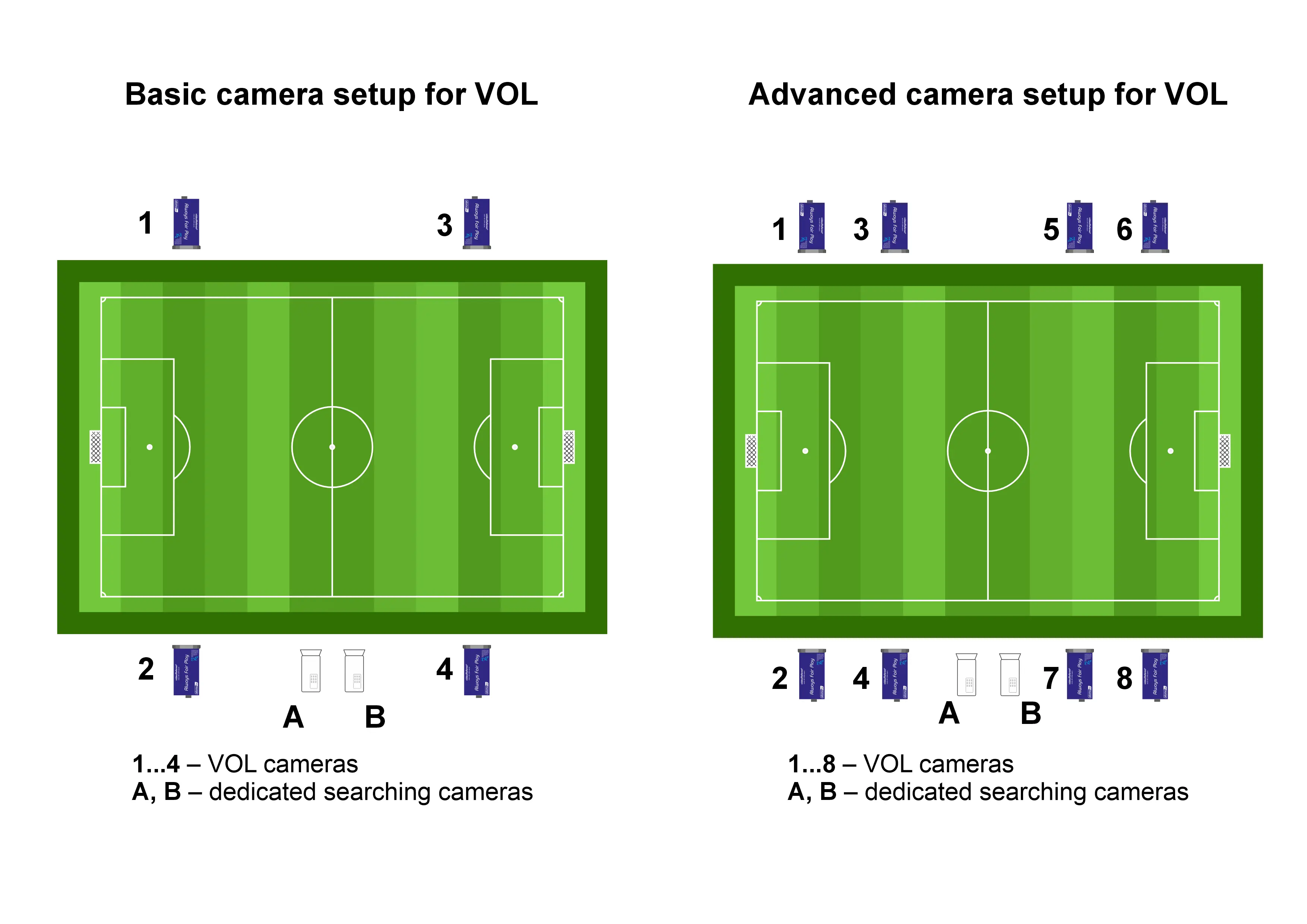
When the VOL system uses cameras positioned close to the pitch edge, errors may occur due to incorrect height determination in the model, if the VOL system does not account for local height differences. For instance, if a camera is mounted 10 m from the pitch edge at human height, and players are at the opposite end of the pitch (up to 50 m away), the offside line drawing error may reach 50–100 cm.
It is also necessary to consider image distortion when using cameras with different focal lengths. In the VOL system, wide angle shots require offside lines to be drawn curved accounting for this distortion.
Another challenge is the need to capture potential controversial incidents with sufficient detail for the VOL system. When relying mostly on broadcasting cameras, it may turn out that in a specific situation no suitable camera was available for offside detection.
Of course, installing a large number of cameras requires substantial equipment investment, but it does improve the accuracy in offside detection.
SLOMO.TV camera setup suggestion
We suggest using stationary offside cameras installed at 16 m from the goal line, perpendicular to the touch line. Four such cameras (two on each side) will reliably capture up to 95% of incidents. Installing eight cameras is ideal. To improve accuracy, using 100-120 fps cameras is also recommended.
VOL solution by SLOMO.TV
SLOMO.TV servers with VOL option apply all the necessary mechanisms for topology accounting and high-speed camera support. By implementing our servers with the abovementioned suggestions, the user receives an accessible, effective tool, both in terms of hardware and decision-making speed, without the need for additional operators.
Full integration with our VAR system
SLOMO.TV VOL is a software option running on the same hardware as our videoReferee® VAR system, not on a separate server. There's no need for additional hardware, and the VOL system is controlled via the native VAR console Control-VR (or a mouse). One VAR system operator can handle both VAR and VOL functions.
User control
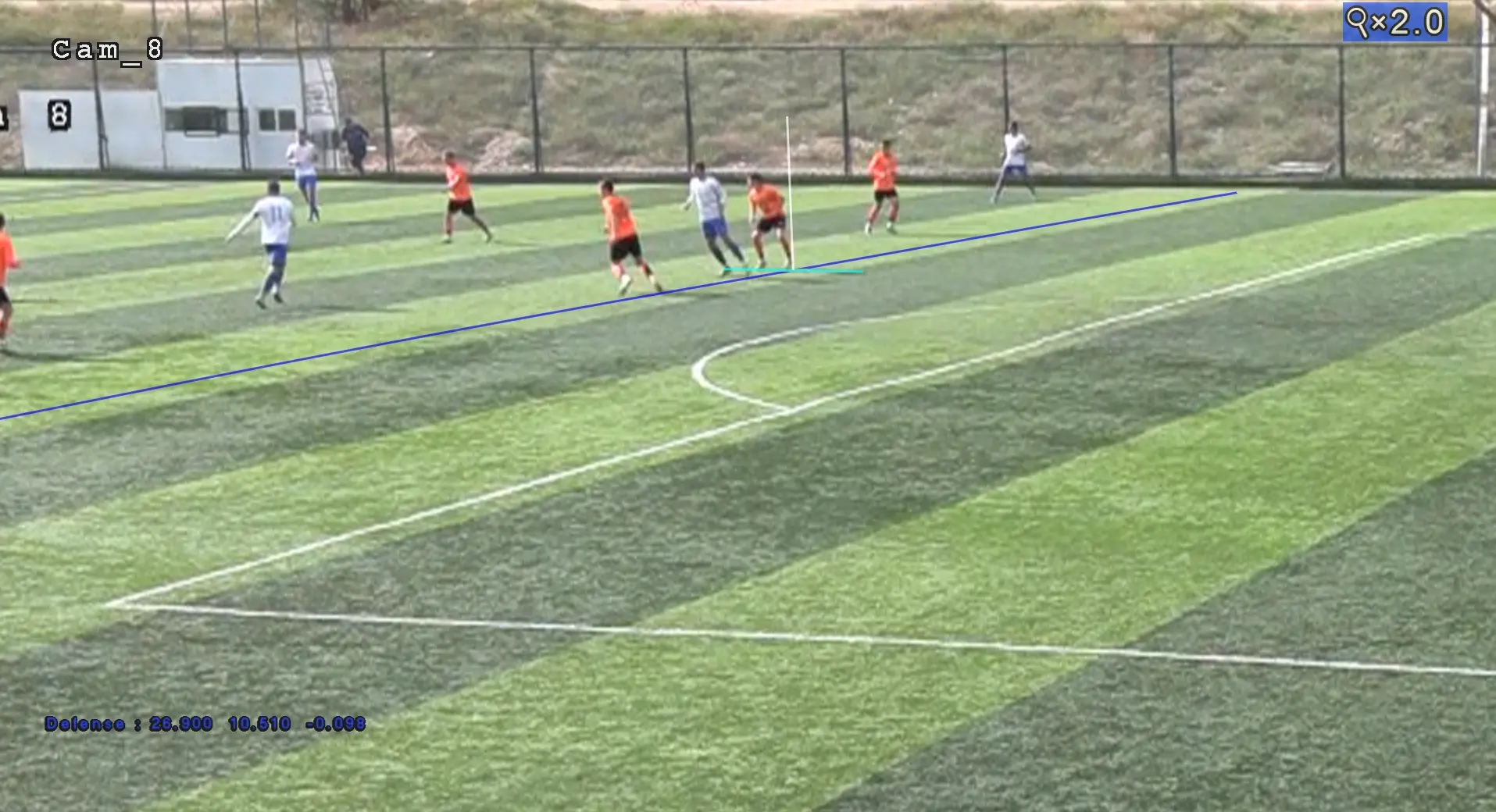
The VOL operator has full control of the system. Using an augmented reality tool (with a 3D crosshair) they can place markers on protruding body parts of players. This tool is displayed simultaneously on all selected cameras, allowing accurate positioning from different angles.
Absolute camera synchronization
Slomo.tv technology synchronizes all video streams with 0.5 frame accuracy, even for the initially unsynchronized cameras. This is imperative for reliably aligning the moment of the pass with the relative positions of the players.
High efficiency
Thanks to an intuitive interface and augmented reality technology, the operator spends up to 30 seconds on a standard incident and up to 60 seconds in complex cases, maintaining game pace.
SLOMO.TV VOL is a fast and easy to operate software-based solution. Integrated into all VAR servers starting in 2026, it is available to all users of our videoReferee® systems.