
The rise of SMPTE ST 2110 in sports broadcasting
The SMPTE ST 2110 standard is rapidly conquering the world of sports broadcasting. ST 2110 allows for significant cost savings in both personnel and materials, and it has inherent redundancy capabilities, enabled through "red" and "blue" subnetworks. For top-tier sporting events — where reliability is non-negotiable — ST 2110 emerges as an ideal solution.
Beyond that, ST 2110 offers unparalleled scalability. Broadcast infrastructures built on this standard can effortlessly expand to accommodate new workflows and technologies. This flexibility is especially critical in sports broadcasting, where innovation cycles are rapid and demands for higher resolutions and more complex graphics are ever-increasing.
A natural evolution within ST 2110 ecosystems is to integrate sophisticated sports graphics and overlay systems, which are essential elements of any professional sports production workflow. The ST 2110 framework enables efficient connectivity for graphics systems, supporting up to 32 channels of 3G or 8 channels of 4K over just two optical cables, which translates to streamlined cabling, reduced equipment footprints, and enhanced signal integrity.
SLOMO.TV's rapier.gfx 2110
Staying at the forefront of ST 2110 advancements, SLOMO.TV has developed the rapier.gfx 2110 — a dedicated sports and broadcast graphics system designed specifically for modern broadcast environments. It's one of the first native ST 2110-based solutions focused on sports graphics – and it delivers exceptional cost-effectiveness without compromising performance.
Built on SLOMO.TV's proven ST 2110 server architecture, the system guarantees broadcast-quality output suitable for the top-level sports broadcasting. Redundancy is seamlessly integrated through dual subnetworks ("red" and "blue"), ensuring uninterrupted operation even in the event of network or equipment failures.
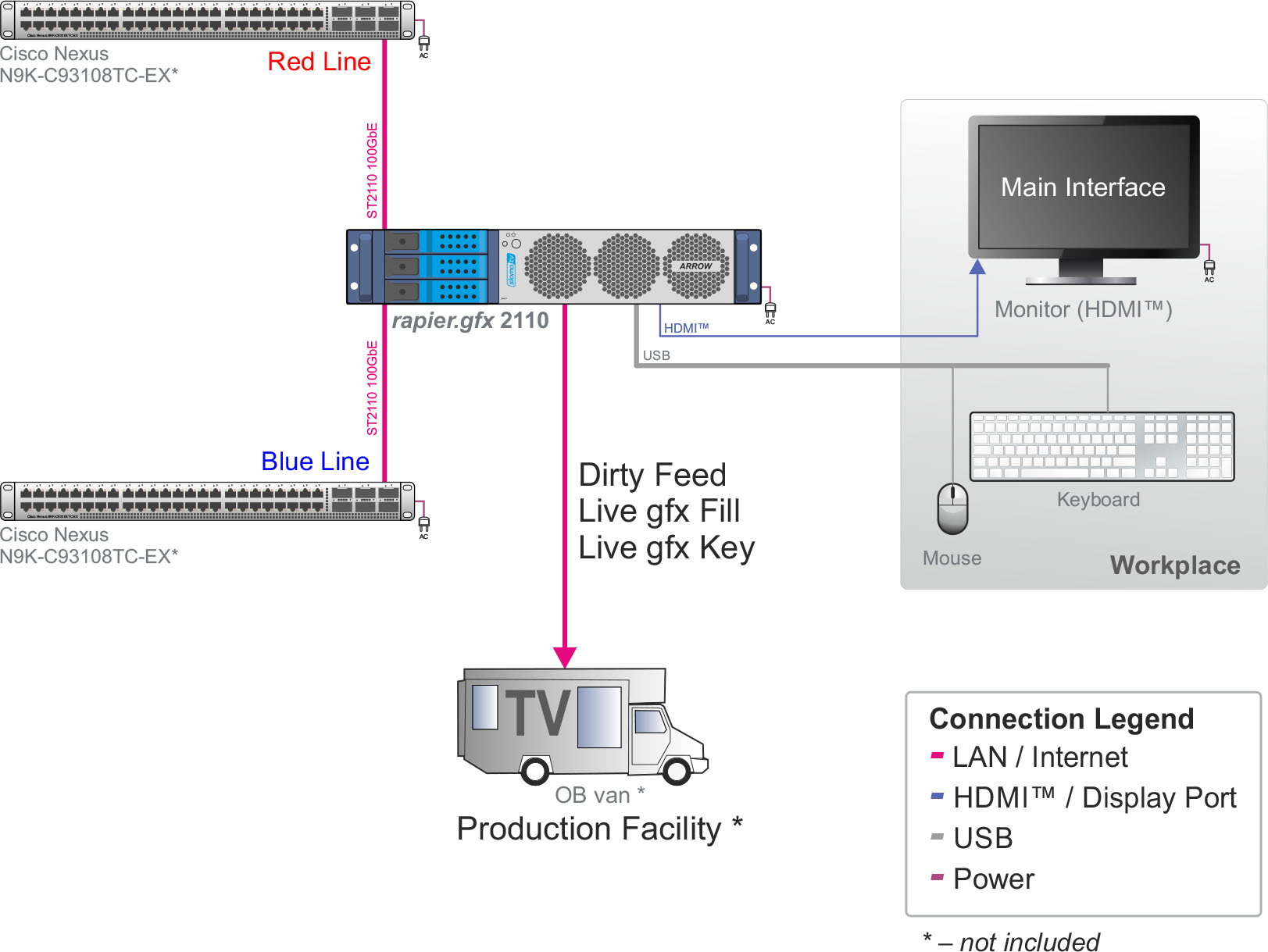
The system has extensive input and output capabilities that can be used for dedicated preview signals and multiviewer outputs to be distributed across various areas of a venue.
Rapier.gfx 2110 supports up to four independent 4K channels, each with its own playlist and graphical elements.
The rapier.gfx 2110 system operates in two primary modes. The first is Internal Keying, where graphics are applied directly to an incoming video stream. The second is external switcher mode, which is compatible with Fill/Key workflows commonly used in broadcast environments and offers greater creative control.
Using real-time data
One of rapier.gfx 2110 standout features is its ability to automate graphics and overlay updates based on real-time data inputs. This capability is transformative for sports production, where scores, statistics, and timing information must be accurate and instantly available.
The system can ingest data from a variety of sources: scoreboard controllers (supplying game state information), timing devices (widely used in athletics, skiing, swimming, and other timed disciplines), external databases. The information can be fed into rapier.gfx 2110 via network connections or RS-422 interface.
Dynamic text objects within the system receive continuous updates from these external sources, ensuring that on-screen graphics reflect the "true real-time" information for the viewers. This automation reduces human error and frees production staff to focus on creative decisions rather than manual data entry.
Rapier.gfx 2110 is also fully compatible with SLOMO.TV's match controller Control-MC — a multi-function timing and event registration system. This integration creates a unified workflow where data and graphics are synchronized seamlessly, eliminating delays and errors.
Additionally, rapier.gfx 2110 includes a built-in scoreboard controller emulator, allowing it to function as a combined scoreboard controller and graphics subsystem. This is particularly valuable for smaller productions or as a backup solution during major events.
Technical features
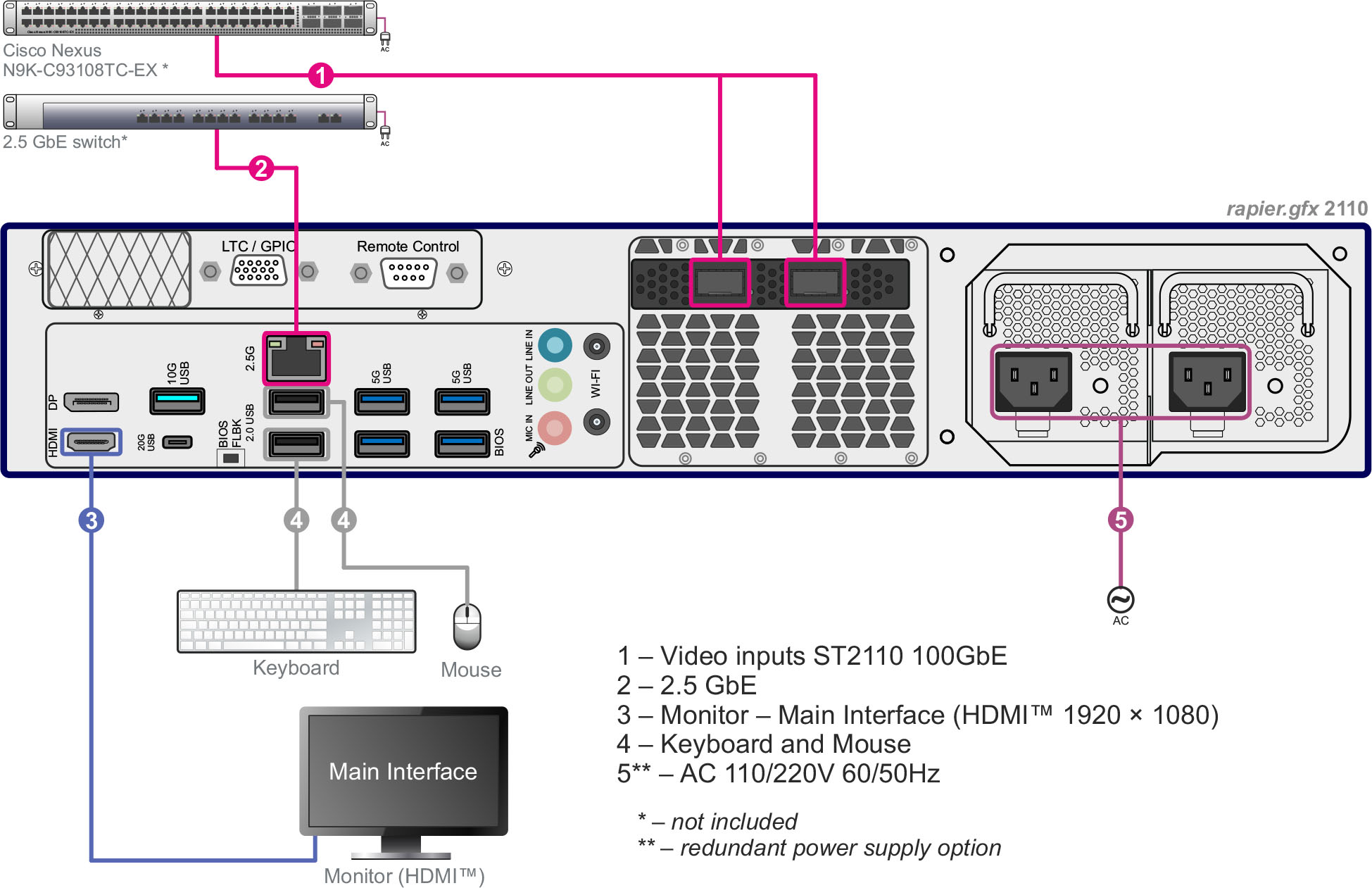
Rapier.gfx 2110 supports a wide range of video resolutions, including HD, 3G, and 4K.
Operation is carried out through a customizable and intuitive touchscreen interface. Production teams can design dedicated control panels with pre-programmed scenarios, enabling quick access to common graphics templates, transitions and overlays. The interface is simple to understand and helps reduce the learning curve for operators.
The system provides a comprehensive toolkit for creating and editing text elements, vector graphics, video clips, and 3D objects. It also has advanced features such as complex animation capabilities, visual effects (including shadows, gradients, and transitions), and object-level audio integration.
In terms of external sources integration, rapier.gfx 2110 is extremely versatile. Camera feeds, including NDI, can be incorporated directly. Databases in formats such as SQL, XML, and CSV provide structured data for dynamic graphics. Local network files offer additional media resources, while web and RSS feeds bring in real-time information from online sources. This flexibility ensures compatibility with existing production workflows and future-proofs the system against emerging data formats.