
videoReferee®-FC – Complete Video assistant referee (VAR) system
videoReferee®-FC – is a modular video assistant referee system (VAR) designed for football. It is configurable for any level of responsibility of the competition. Slomo.tv provided this system for VAR training during the first FIFA VAR Instruction Course.
Slomo.tv's VAR system combines compact size, ease of use and compliance with all the requirements of international football federations and competitions.
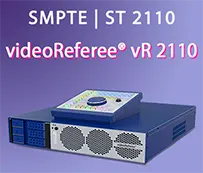
videoReferee®-FC – is the most powerful VAR system in the world. One 4U server provides simultaneous support of up to 32 3G/HD video input channels. A large number of channels allows working not only with standard cameras, but also with Super Slow Motion cameras (each requiring up to 4 input channels), and provide necessary number of VOR cameras in accordance with the requirements.
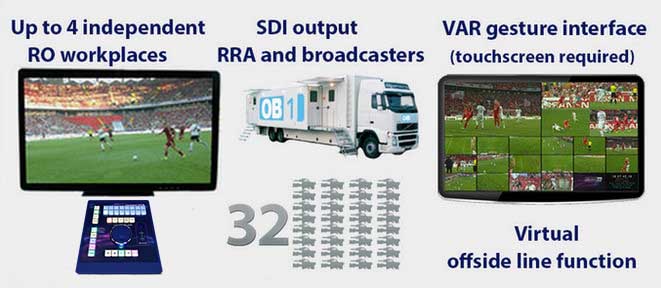
Thanks to the option of having up to 4 independent work places, additional assistants VAR (AVAR) and replay operators (RO) can in the background prepare video material, which could be of potential interest for review by VAR. Should VAR require it, it can be instantly transferred to the main workplace for review.
Quad screens for each operator can be created using individual presets. For example, the left and right halves of the field. This speeds up the process of search and camera selection, which clearly shows the controversial moment.
The ability to configure the system allows you to adapt it to different conditions depending on the stadium or the requirements of a particular football competition.
videoReferee®-FC – is:
- Simultaneous support for up to 32 3G/HD video channels
- Up to 4 independent work places (VAR / Assistant VAR / Replay Operators)
- Fast preparation of video materials for VAR's and referee's review
- Support of Super Slow Motion cameras
- Up to 3 seconds (75 frames) adjustable delay in displaying of the Main Camera on VAR monitor. This is necessary to ensure that a controversial moment seen on the main camera, could be instantly watched it on the VAR monitor
- Integration with the most popular Referee Intercom system Vokkero
- Analysis of controversial moment at normal and slow motion speed
- ZOOM and Frame-by-Frame viewing makes the key moment always visible
- Virtual offside line function
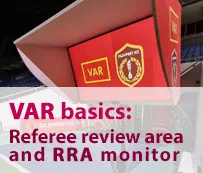
- SDI output for broadcasters and for the replay review area (RRA) monitor on the field
- Specialized VR-Keypad for each workplace, which provides instant access to the necessary cameras and allows to work with preconfigured 2, 3, 4 cameras presets
- Quick creation of the VAR Multiscreen with 2, 3, 4 cameras
- Three (3) back-lit RGB buttons for: controlling communication between VAR and referee on the pitch; events marking and timing control
- Intuitive interface when working with Multiscreen
- Flexible and fast creation and use of Multiscreens
- Dimensions: 4U, 19.5 kg
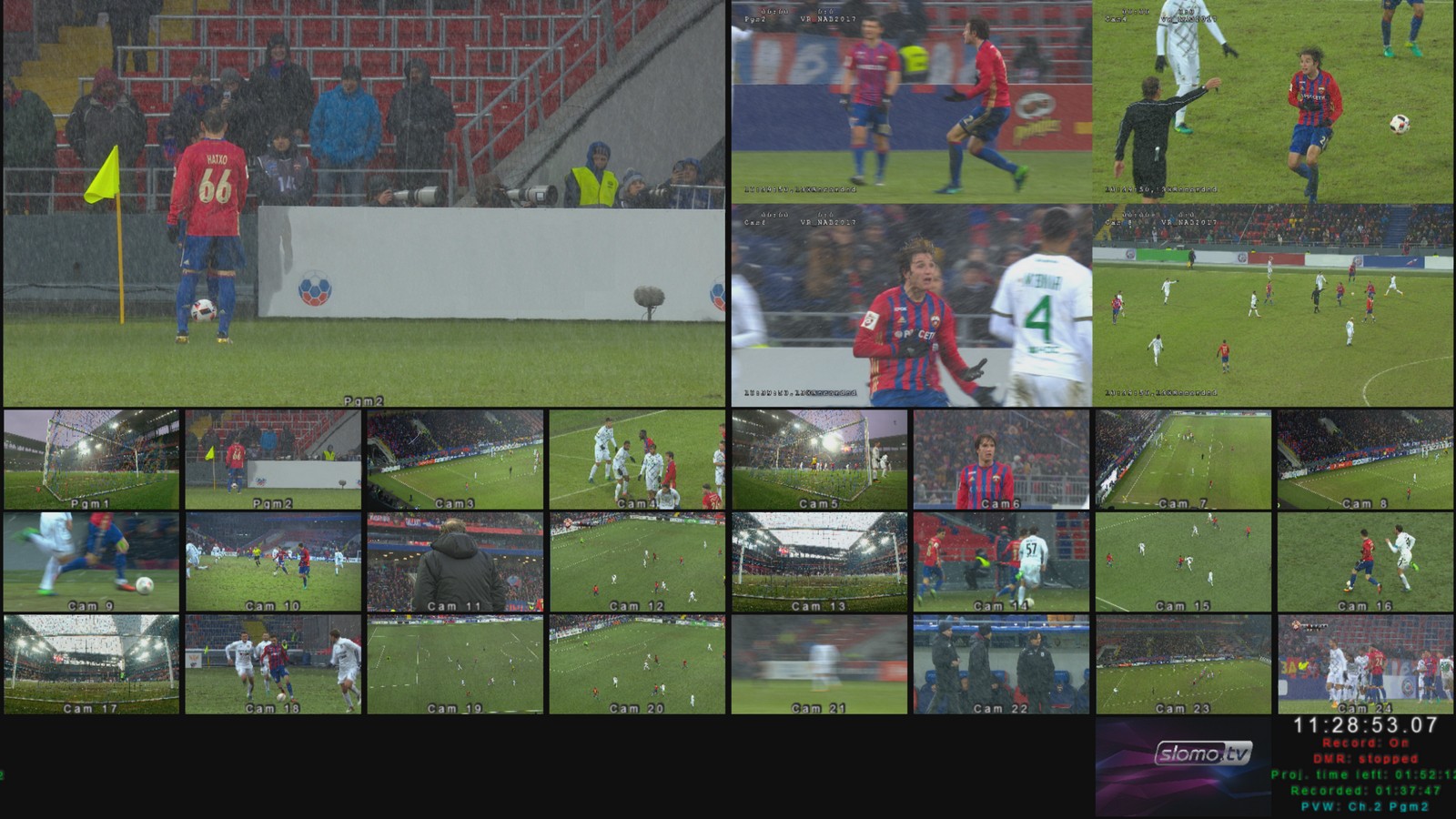
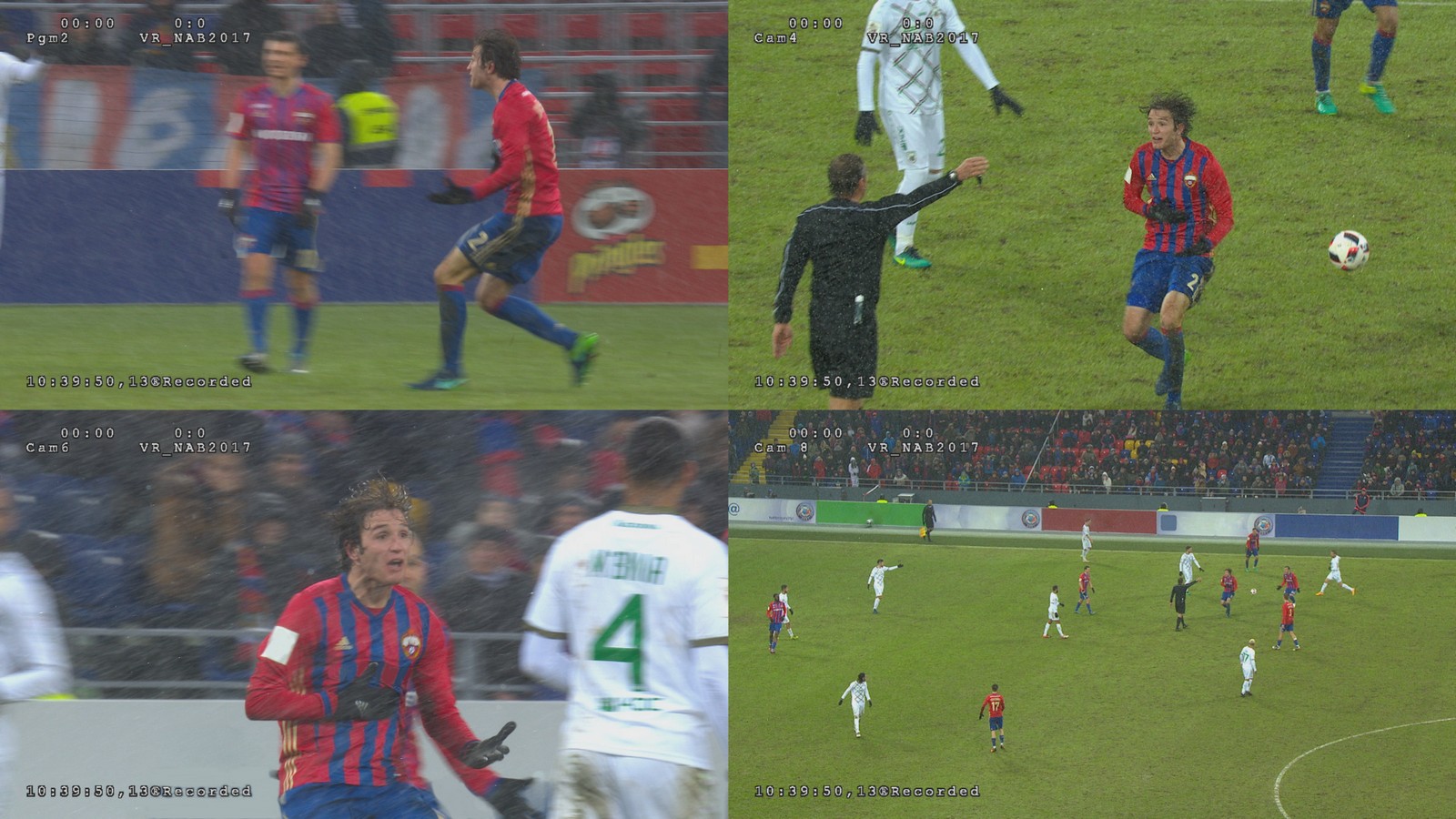
videoReferee®-FC meets all FIFA requirements for VAR systems
Presence of the red referee button for controlling the communication between VAR and referee allows avoiding accidental interference with referee’s communication.
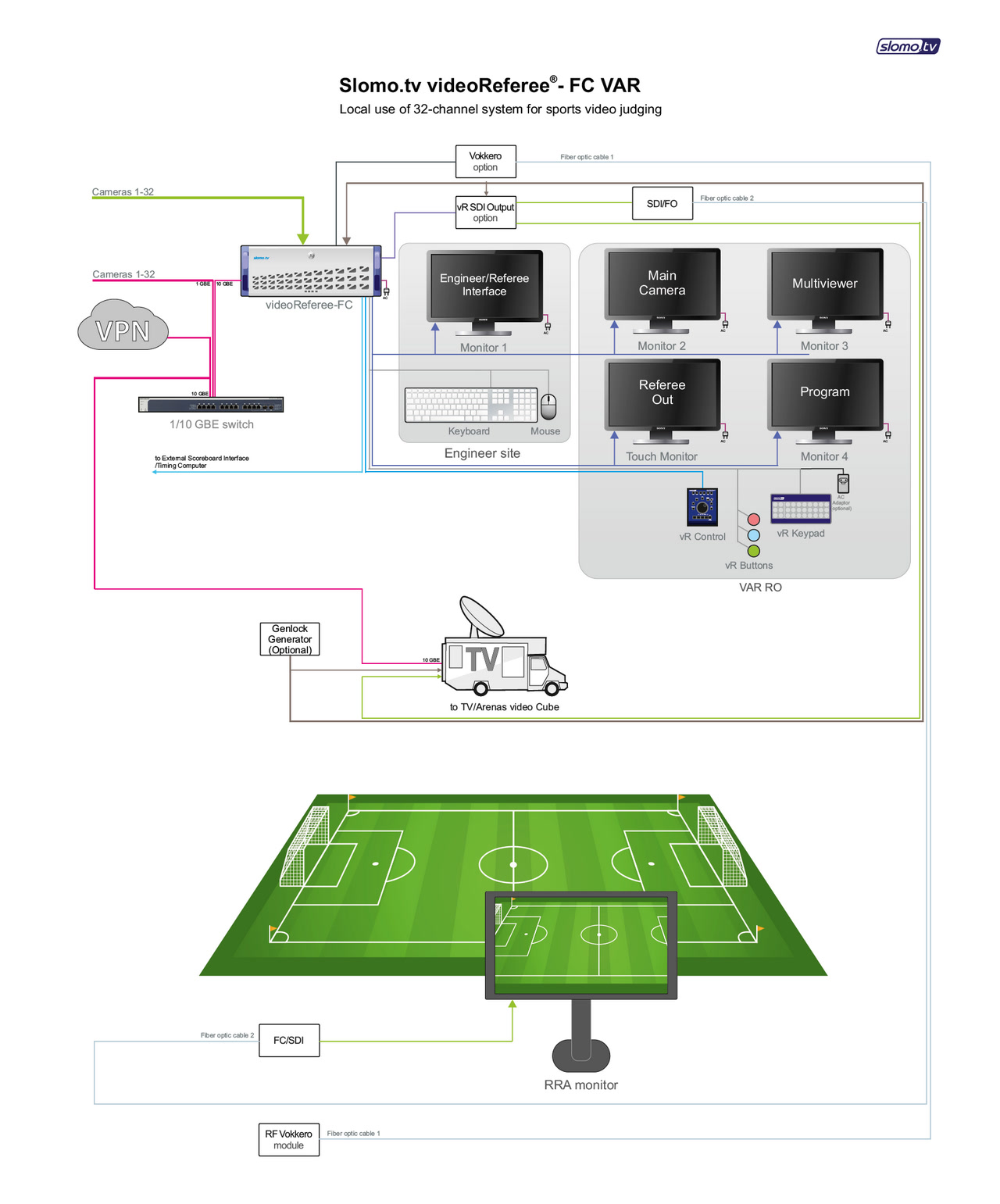
The system has a separate SDI video output for the monitor installed in the replay review area on the field. At the request of the referee, the video can be transferred to the RRA, as well as a quick change of camera, the number of cameras or playback speed.
VAR Solutions
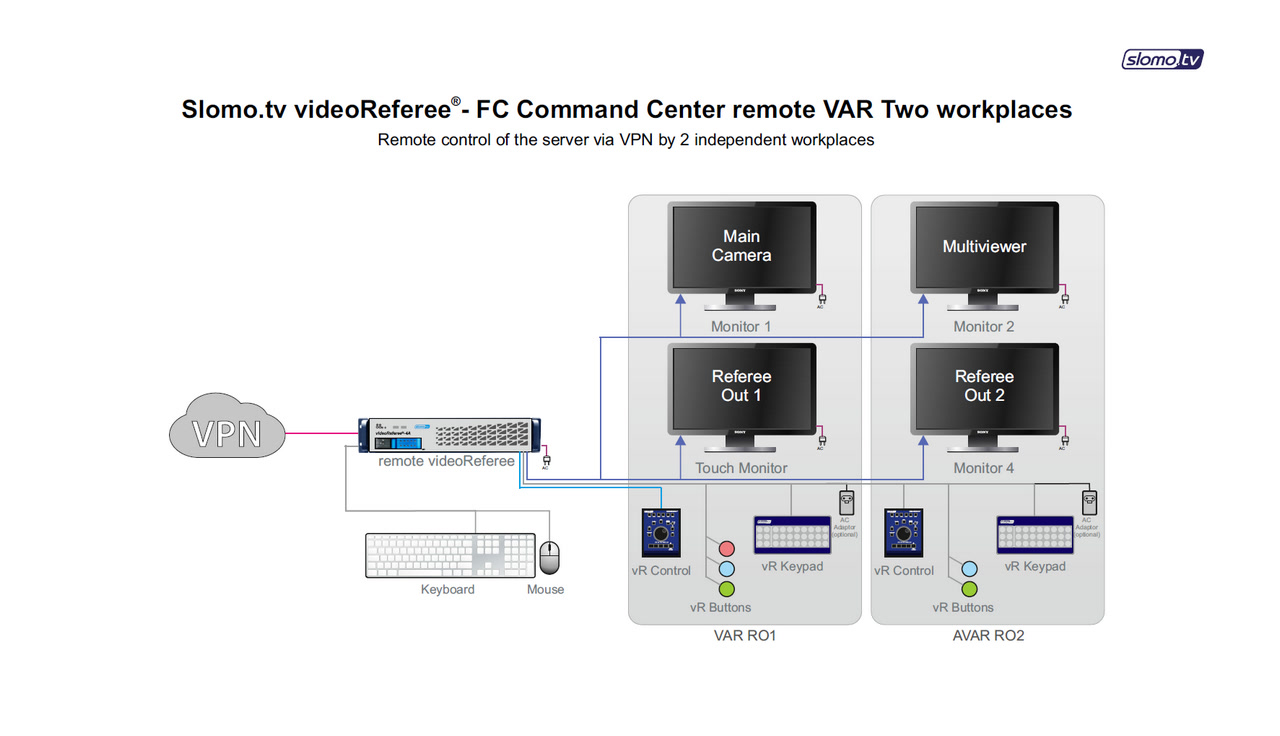
videoReferee®-FC system can be installed in the VOR room on the stadium as well as in its immediate vicinity. However the systems networking ability allows it to be fully managed from a remote command center via VPN connection.
Up to 2 independent workplaces can be connected to the system this way. The work of operators and video judges is absolutely identical to local installation.
|
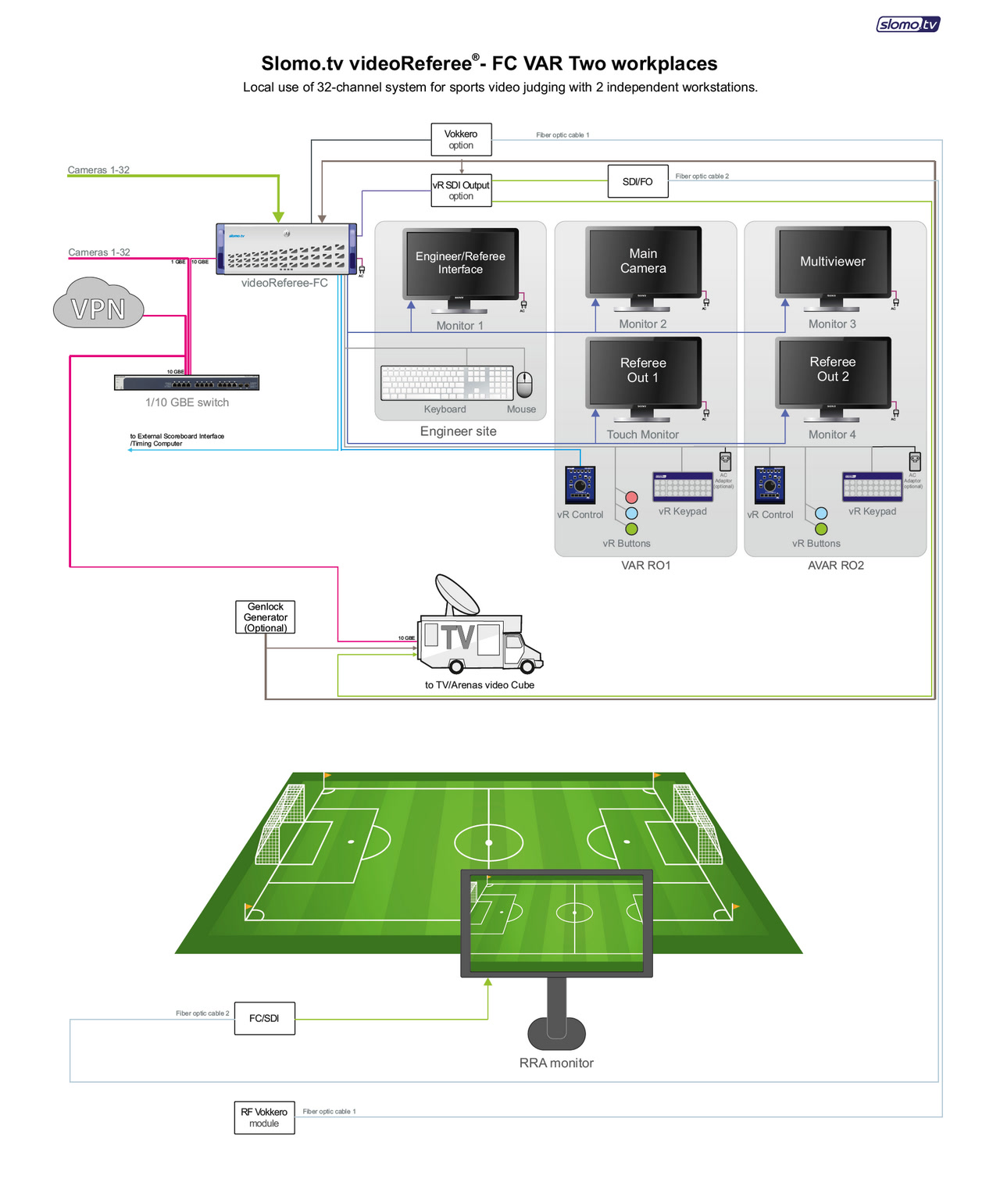
Slomo.tv videoReferee®-FC VAR Local use of 32-channel system for sports video judging |
|
|
|
Slomo.tv videoReferee®-FC VAR Two work places Local use of 32-channel system for sports video judging with 2 independent workstations |
|
|
|
SLOMO.TV videoReferee® Command Center remote VAR Two work places Remote control of the server via VPN by 2 independent workplaces |
|
| Parameters | videoReferee®-FC |
|---|---|
| Inputs | |
| 3G*/HD/SD-SDI | 32 |
| Video Formats | |
| 1080i | 50i / 59.94i |
| 1080p | 29.97PsF / 25PsF / 50p / 59.94p / 100p / 119.88p |
| 720p | 1280 x 720 - 59.94p / 50p |
| SD | 720 x 480 - 29.97 PsF / 59.94i; 720 x 576 - 25 PsF / 50i Support of 16:9 and 4:3 |
| Channels (simultaneously) | |
| 3G*/HD/SD | 32 Recording; 1 / 2 / 3 / 4 Search; 1 Playout |
| Video Standards SDI | |
| HD/SD |
HD video conforms to SMPTE 292M, SMPTE 274 720p video conforms to SMPTE 296M SD video conforms to SMPTE 259M |
| 3G | 3G video conforms to SMPTE 424M / SMPTE 425M |
| Interface monitor | 4 (via Display Port) |
| Referee output for broadcast | HD SDI |
| Multiviewer | Up to 34 video windows. 2 Layouts Embedded touch screen control |
| Compression | |
| Recording | I-Frame DCT Based / AVC-Intra 100 option |
| Export formats | M2TS; MPEG-4 (*.mp4); H264 (*.mp4); DVD XDCAM 50 (*.mxf) (only for HD) |
| Internal storage | SSD |
| Storage capacity | 16 / 32 TB 168 / 336 hrs. Full HD video |
| Audio Inputs | 2 embedded audio channels per video channel (embedders are not included) |
| Audio Outputs | MB audio output / DP*** |
| Number of workplaces | Up to 4 Referee, 2 Replay Operators, Assistant |
| Scoreboard Interface**** | Yes / PIP from any camera |
| Controls |
Up to 2 specialized Jog/Shuttle controllers (via RS-232 / RS-485 / USB / Ethernet); Up to 4 specialized keyboards videoReferee®-Keypad; keyboard, mouse. |
| Referee buttons | 3: Green (mark events); Red (intercom control); Blue (timer control). Via USB connection. |
| Virtual offside lines | Yes. By Deltacast |
| Referee intercom integration | Native Vokkero support with adjustable audio level control |
| Additionally | Ability to network with slomo.tv servers |
| Data exchange | 10 GbE (Network); USB 3.0; Built-in 3.5" SATA HDD Rack |
| DMR™ RACK | 1 |
| Control from HQ via Internet | Yes |
| Maximum connections distance | SDI up to 110m; 3G-SDI up to 90m; Control up to 150m; DP up to 5m |
| Power Consumption | 350 W |
| Power | 110V/60Hz or 220V/50Hz; Redundant PWR Supply |
| Chassis | 4U, 19" |
| Dimensions (H x W x L) mm | 176.5 х 484 х 560 |
| Weight Kg | 19.5 |
|
Notes: * – 3G-SDI Level A, Level B support. ** – Shareable. *** – in some configuration audio out is possible via DP. **** – Supported: Westerstrand, Nautronic NTpult, Nautronic NAUCON-1000, Bodet, Omega Saturn, Megalux, NataInfo, Victory, VITA, Araneus–NGLight, ElTablo, Stramatel, Colosseo, CEDR, Favero Console-700. |
|
- Up to 3 additional work places
- Vokkero Intercom integration
- SDI video output for broadcasters and for replay review area (RRA) monitor
- Virtual offside line function
- SuperMo for working with Super Slow Motion cameras
- VOR room equippment (2 VOR cameras and a microphone)
- Training of the replay operators
VOL (Virtual Offside Line)
VOL (Virtual Offside Line) is a system designed to accurately assist football referees in offside situations. As an integral part of the VAR (Video Assistant Referee) ecosystem, VOL system by SLOMO.TV combines advanced 3D calibration techniques, video synchronization, and human expertise to help make well informed decisions.
Basic principles
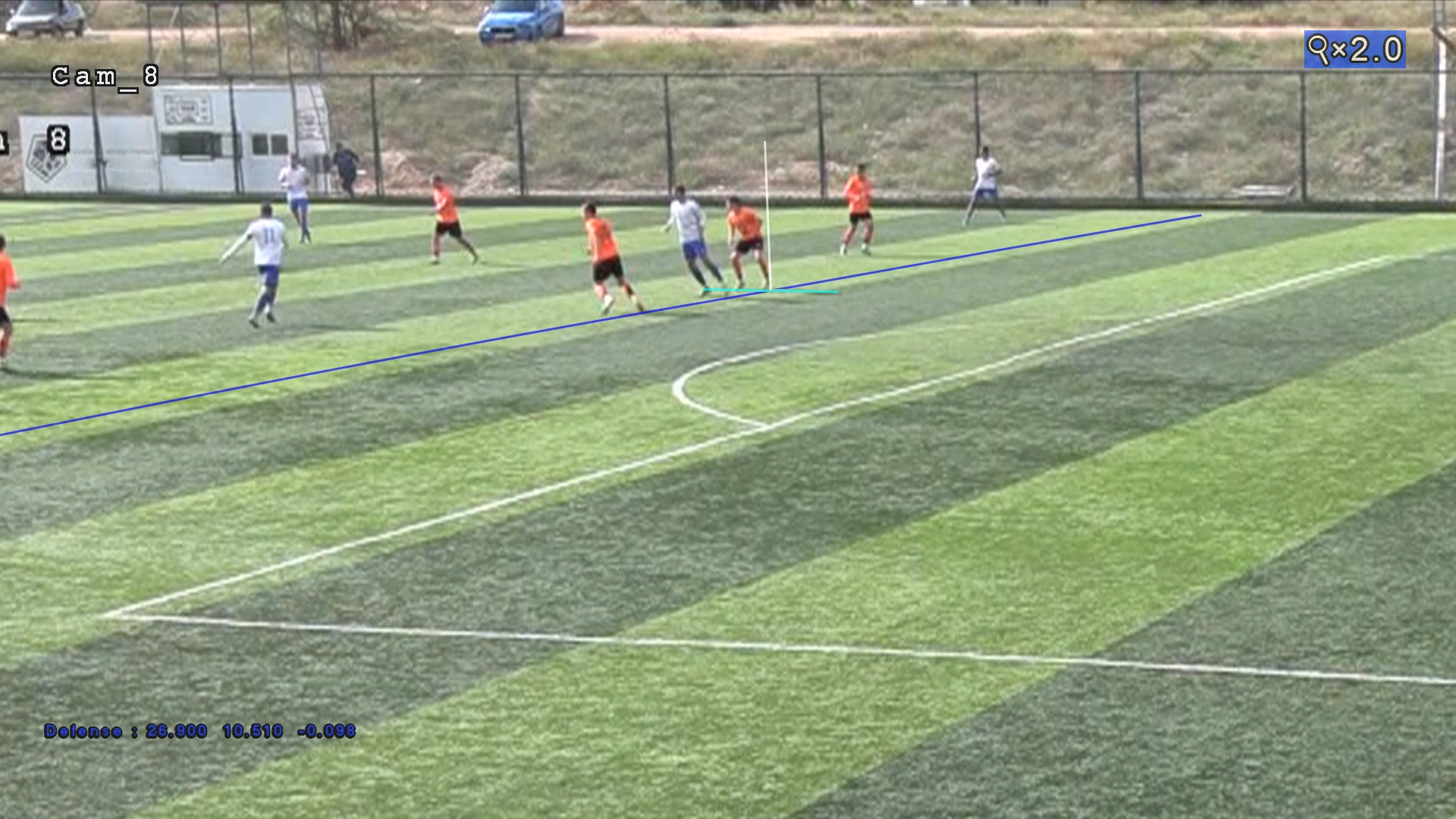
Unlike older 2D systems that were used to project lines onto the pitch plane, VOL technology is designed to solve a three-dimensional problem. It determines the position of key body points of the involved football players (legs, torso) at the moment of the pass in real 3D space.
Key stages of offside detection:
- Locking the moment of the pass: Specialized cameras determine the exact moment when the ball is touched by a player from the passing team.
- 3D-scene construction: The VOL system analyses the position of all players relative to the goal line, using data from synchronized cameras and considering the actual pitch topography (irregularities of the field).
- Position analysis: The position of the attacking player is compared with the position of the second to last defending player.
Difficulties of the VOL system operation process
To accurately detect offside in football, numerous factors related to the geometry and topology of the football pitch must be considered. In this article, we will examine the main challenges faced by Virtual Offside Line (VOL) systems.
The perfect football pitch
An ideal football pitch should comply with FIFA recommendations regarding dimensions, markings, and surface parameters, and should be perfectly flat.
However, deviations are allowed, which may affect the performance of the VOL system.
Deviations in line markings
Some football teams may adjust their line markings at the home pitch. Minor changes in line markings become a tactical tool for the home team and may affect the correct rendering of offside lines by the VOL system.
In our practice, we have also encountered situations where pitch markings were asymmetrical relative to the half-way line. This may lead to errors when drawing the offside lines. In reality the deviations may be 10–20 cm in either direction – a significant difference for offside decisions.
Moreover, we've met cases where the main pitch marking rectangle (touch lines and goal lines) forms a rhombus or trapezoid instead of a rectangle. With a pitch length of 100 m, the error may amount to about 0.1%. However, when the VOL system is expected to detect offside with 1 cm accuracy, this error becomes significant and affects decision making.
Topological features of the football pitch
A football pitch is a complex structure and is not always perfectly flat. The pitch’s drainage system ensures water flows towards the edges to prevent stagnation, resulting in bulges in the center and slopes at the edges.
For the VOL system to operate correctly, three-dimensional pitch parameters must be considered. Any irregularities complicate the drawing of a straight line due to potential distortions, which may affect the final offside detection.
VOL system and cameras
When the VOL system uses cameras positioned close to the pitch edge, errors may occur due to incorrect height determination in the model. For instance, if a camera is mounted 10 m from the pitch edge at human height, and players are at the opposite end of the pitch (up to 50 m away), the offside line drawing error may reach 50–100 cm if the VOL system does not account for local height differences.
It is also necessary to consider image distortion when drawing offside lines. Shooting with cameras of different focal lengths leads to distortions where straight lines appear curved. In the VOL system, wide angle shots require offside lines to be drawn curved accounting for this distortion.
Improving VOL system performance
When working with a regular, non-ideal football pitch, we face numerous complexities that must be considered. To correctly draw the offside line, pitch and line marking measurements are required, along with constructing a topological model of the entire pitch, including all three-dimensional irregularities. Additionally, it’s worth considering to use cameras that reduce the likelihood of VOL system errors.
Creating a model of the pitch
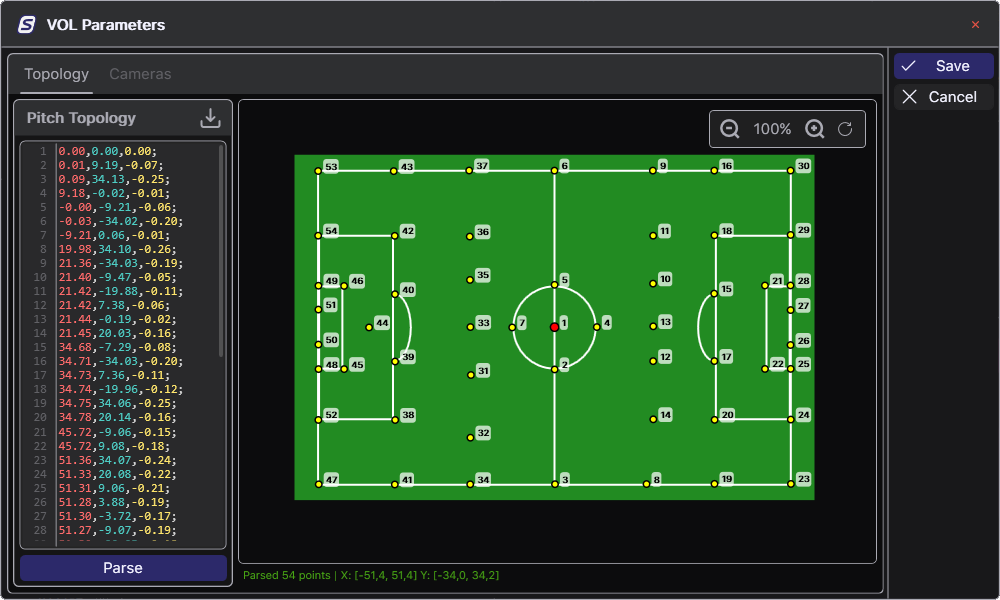
Let's consider a regular football pitch with known topological coordinates for standard points (31–35 points) which are uploaded to the VOL system. If a disputed incident occurs near standard points within 1 m, the VOL system operates with high accuracy.
However, an incident may also occur at a considerable distance from known points. Given that depressions and bulges are distributed across the pitch, a more accurate three-dimensional topological pitch model must be created to ensure acceptable VOL system accuracy. This requires a grid with a larger number of points.
In our opinion, an acceptable grid for normal VOL system operation has a cell size of 2×2 m. The optimal grid has 1×1 m cells. This is a substantial pitch measurement task, but it enables accurate line drawing.
Of course, performing topology scans before each match is costly and impractical. For each pitch where matches may be held, a topological map must be created – a 3D object onto which the current actual pitch dimensions and line markings can be overlaid. This allows offside lines to be drawn as accurately as possible on a three-dimensional surface, as relative coordinates and necessary measurement heights will be known.
📄 Our guide to collecting field topology data for VOL technology
Optimizing cameras for offside detection
Another challenge is the need to capture potential offside incidents with a camera providing sufficient detail for the VOL system. When using broadcasting cameras, it may turn out that no suitable camera was available for offside detection in a specific situation.
This is addressed by installing fixed cameras that are always capable of capturing complex incidents. For example, the Premier League uses 30 cameras for precise fixed offside detection. They allow accurate determination of player positions in three-dimensional space.
Installing a large number of cameras requires substantial stadium equipment investment but guarantees high accuracy in offside detection and resolution of disputed incidents.
Our recommendations
For maximum efficiency within reasonable budgets, the following steps can be taken to improve VOL system accuracy:
- Perform topological pitch measurements twice: at the start of the season and in the mid-season. Also, perform pitch topology scans whenever pitch parameters change – e.g., when line markings are significantly altered or the turf is replaced. (📄 Instructions for collecting field data for using VOL technology).
- Whenever possible, conduct topological scanning of main pitch points (31–35 points) during line marking. Estimated task duration: 2 hours.
- Use special 16 m cameras positioned on each side of the pitch to capture the maximum number of disputed incidents.
- Ensure fixed cameras are synchronized with broadcasting cameras; otherwise, errors may reach up to 10 cm when capturing at 50i/50p.
- It is not enough to rely only on high-speed cameras (100-120 frames per second). Using four dedicated offside cameras and one overview camera can significantly reduce coordinate detection errors.
Main advantages of our VOL system
Our solution has the following technological and operational advantages:
🔗 Full integration with our VAR system
VOL is a software option running on the same hardware as our VAR system, not a separate server. This means:
- No need for additional hardware or control units
- Control is performed via the native VAR console (or mouse)
- It saves a lot of resources: takes no extra space, needs no extra purchases, and one operator can handle all functions
🎮 User controlled
The VOL operator has full control. Using an augmented reality tool (with a 3D crosshair) they can place markers on protruding body parts of players. This tool is displayed simultaneously on all selected cameras, allowing accurate positioning from different angles. This eliminates errors of relying on abstract player models
🌍 Consideration of the pitch topology
A football pitch is not a perfectly flat plane. The system requires mandatory pre-match calibration to create an accurate 3D model of the pitch, accounting for all depressions and mounds. This takes less than a minute per camera and ensures decisions are based on the stadium’s real geometry
⚡ Absolute camera synchronization
SLOMO.TV technology synchronizes all video streams with 0.5 frame accuracy, even for the initially unsynchronized cameras. This is imperative for reliably aligning the moment of the pass with the relative positions of the players
⏱️ High speed
Thanks to an intuitive interface and augmented reality technology, the operator spends up to 30 seconds on a standard incident and up to 60 seconds in complex cases, maintaining game pace
⚙️ Technical information
📐 Infrastructure recommendations
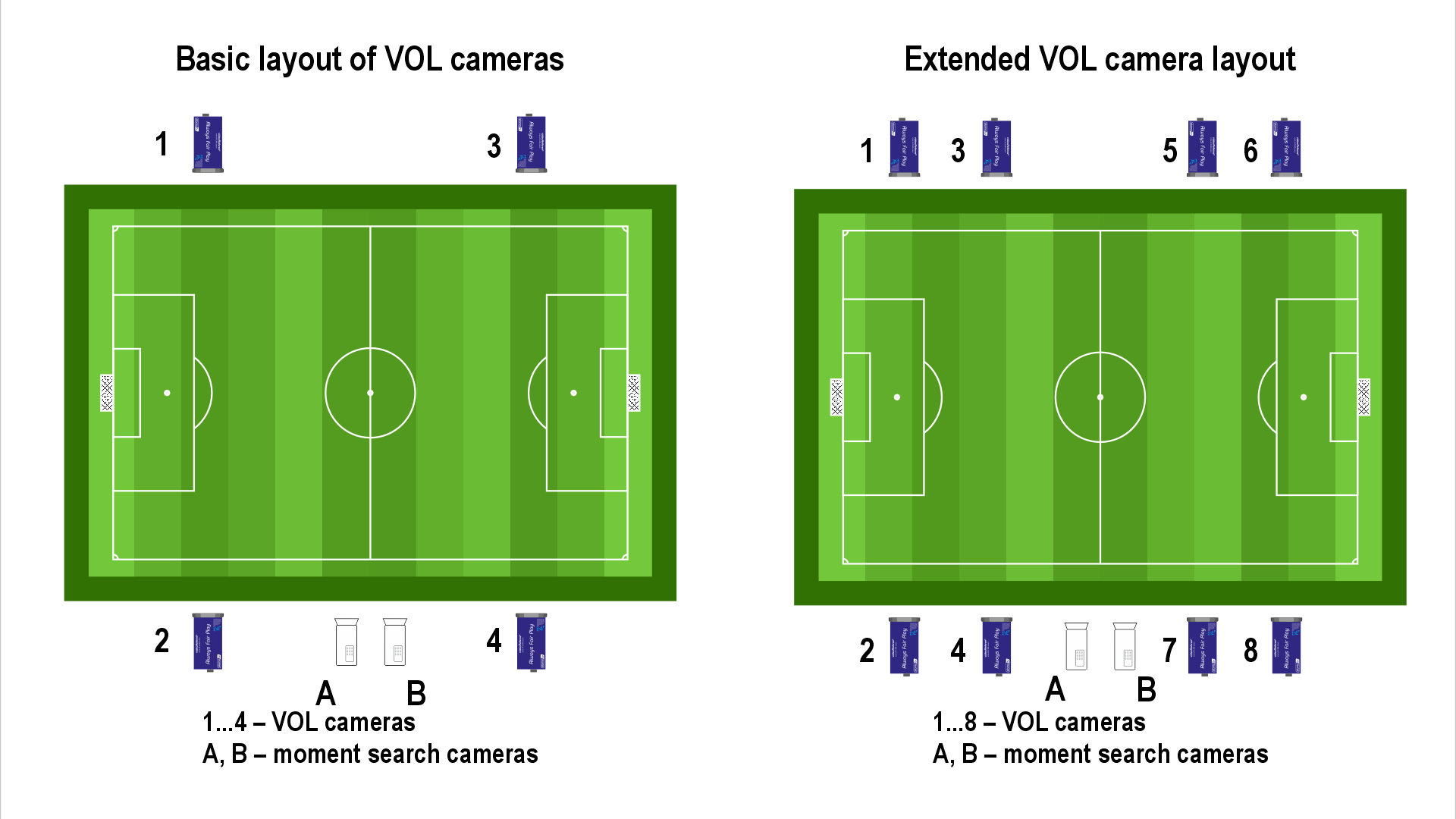
- Fixed cameras: We recommend using stationary offside cameras installed at 16 m from the goal line, perpendicular to the touch line. Four such cameras (two on each side) reliably capture up to 95% of incidents. Installing eight cameras is ideal
- SuperMotion cameras: To improve accuracy, using 100-120 fps cameras is recommended (for example, the mini-2x-vR-Cam). Standard 50 fps cameras have a margin of error of 4–20 cm. SuperMotion cameras halve this error, making it possible to evaluate disputed moments when the differences measure in centimeters
🧩 Hybrid VAR architecture
When using a VAR Center configuration as a VAR solution (a central hub equipped with the VAR system and VAR workstations), increasing the number of cameras requires expanding communication channels.
SLOMO.TV offers a hybrid approach, where the VAR server is installed at the arena directly, while the VAR workstations and the VAR team are located in a remote VAR Center. This way, adding 4, 8, or 16 cameras does not change the signal transmission requirements, as everything is handled locally.
🔌 Connectivity
SuperMotion cameras (such as mini-2x-vR-Cam) connect via a standard Ethernet network with PoE power supply. The cloud synchronization technology allows the system to be scaled to meet any requirement without loss of quality
VOL by SLOMO.TV is a fast, accurate, and reliable solution. Integrated into all VAR servers starting in 2026, it is available to all users of our systems as part of standard technical maintenance.
videoReferee®-FC includes
- 4U server with support for up to 32 3G/HD video channels
- 4 graphic outputs that can be used for display of:
- Main camera
- Referee interface operating in the following modes:
- Delayed video from the main camera or delayed Multiscreen of 2, 3 or 4 cameras
- Step-by-step search on recorded material
- Playback of a selected camera with adjustable speed
- Multiviewer
- Engineering interface
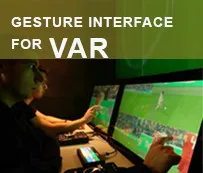
- Requires VAR touchscreen monitor for gesture control (Purchased by the user)
- Back-lit RGB buttons: blue-to start the stopwatch, green – to mark events, and red to enable radio exchange with the referee on the field
- 1 RO work place
- Specialized controller VR-Control
- VR keyboard
- Standard keyboard
- Mouse
Note: videoReferee®-FC can be custom-made with a reduced number of video channels.