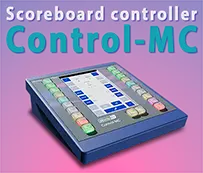
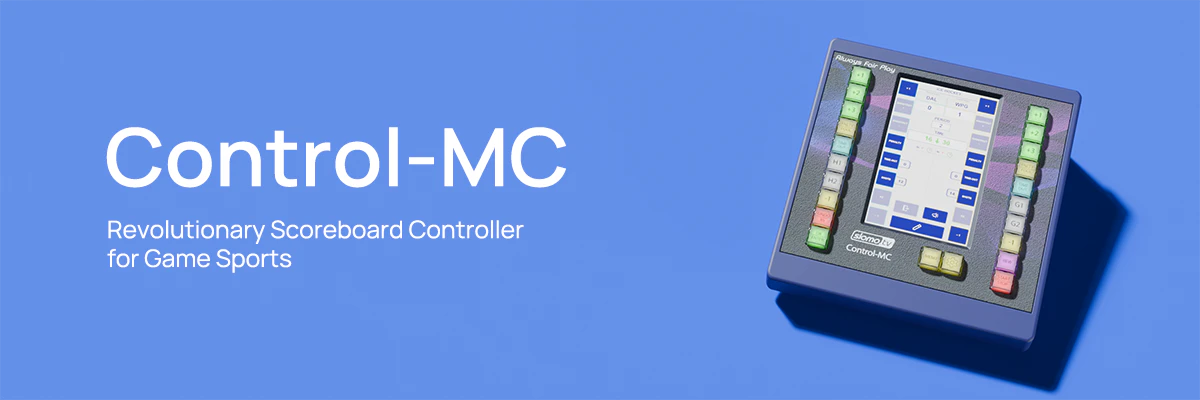
Scoreboard controller Control-MC
Multifunctional timing in-game event registration system with informational and graphics support for arenas and broadcasts
The Control-MC is the result of our 15-year experience integrating various scoreboard controllers with the slomo.tv videoReferee® VAR systems and into arena infrastructure. The system, containing hardware and software modules, allows to perform timing and logging the in-game events in the simplest and most convenient way. The new system was named match-controller (MC). Control-MC provides timing and event data (MCD) to any data user as quickly, reliably and comfortably as possible.
The Control-MC system stands out for its accuracy, reliability, connection flexibility and important additional features that are not available in other solutions.
Compared to the previous generation of scoreboard controllers, Control-MC combines modern IT technologies with time-tested hardware solutions for timing, transmission of data and push-button interface for most important functions. It also extends the functionality of standard scoreboard controllers, namely increases the comfort of work, simplifies operation and facilitates the integration of individual data users. The Control-MC supports a variety of sports, including ice hockey, basketball, water polo and handball.
REVOLUTIONARY SCOREBOARD CONTROLLER FOR GAME SPORTS
SEAMLESS AND EASY REPLACEMENT OF PRE-GENERATION SCOREBOARD CONTROLLERS
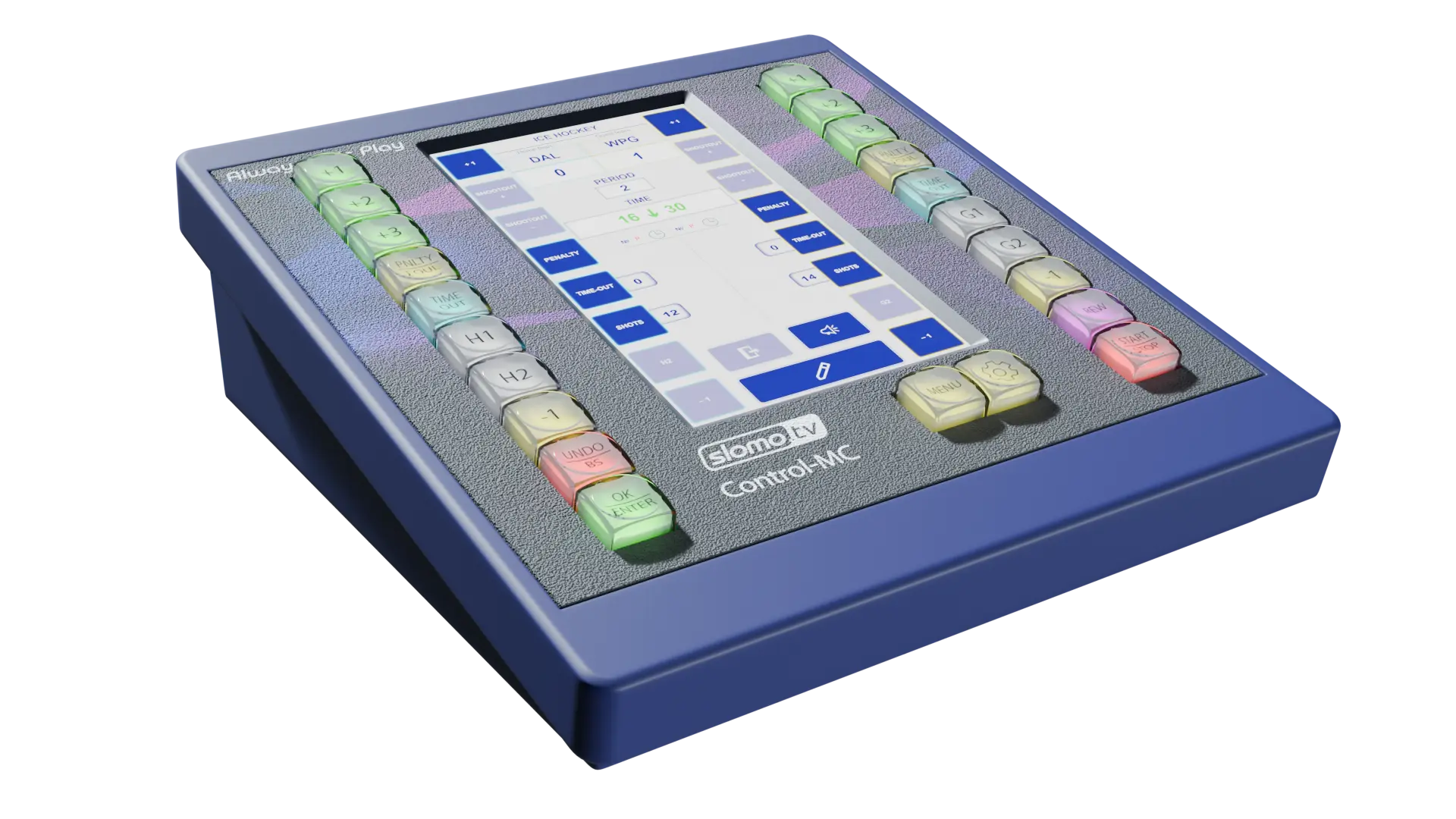
The heart of the solution, the Control-MC, combines a specialized microcontroller-based device responsible for timing and transferring match-controller data (MCD) to all MCD users, with an SoC-based interface powered by Linux OS that enables easy and convenient data entry and correction, configuration, starting and stopping of the system.
Control-MC with its compact dimensions has:
- 22 large, highly reliable RGB push-buttons with tactile feedback and with functional contextual backlighting determined by the type of operation providing fast and convenient work even in the dark
- 7" color TFT touchscreen interface for displaying game information and working with non-operational menus
- Multiple interfaces for connecting additional controls and integration into existing infrastructure (significantly more interfaces than other devices)
- Two Ethernet ports (RJ-45) for connecting additional controls and monitoring devices
- Built-in rechargeable Li-ion battery for up to 6.5 hours of continuous operation
Unlike other solutions on the market, Control-MC has a dedicated controller board for time calculation and MCD transfer. The entire interface is provided by an external device based on a 4-core ARM CPU. This ensures that the time is always accurate and its calculation does not depend on the functioning of the main interface.
The Control-MC's timing system is based on a high-precision temperature-compensated quartz oscillator and programmable timers.
The Control-MC is distinguished by its multiple and simultaneous emulation of operation and protocols of the industry's most popular scoreboard controllers, namely Nautronic (Nautronic NTpult, Nautronic NAUCON-1000), Favero Console-700, Omega Saturn, Bodet.
Flexibility in connecting MCD users and external devices
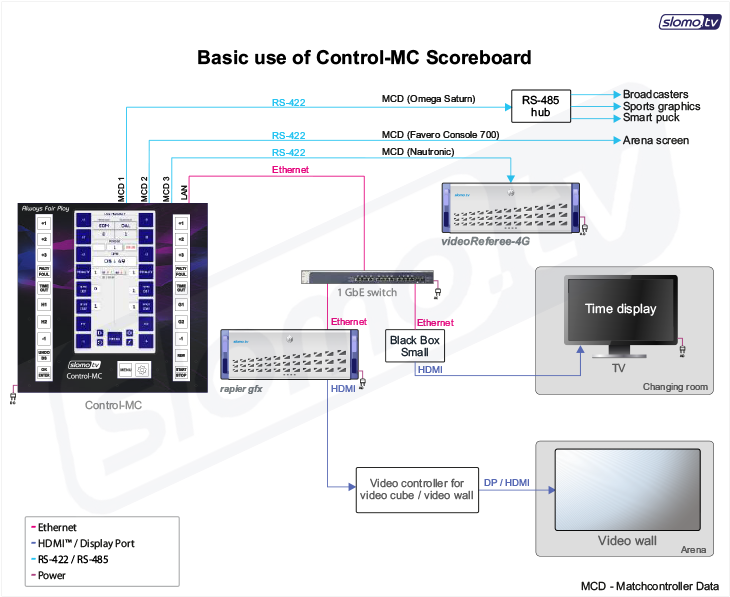
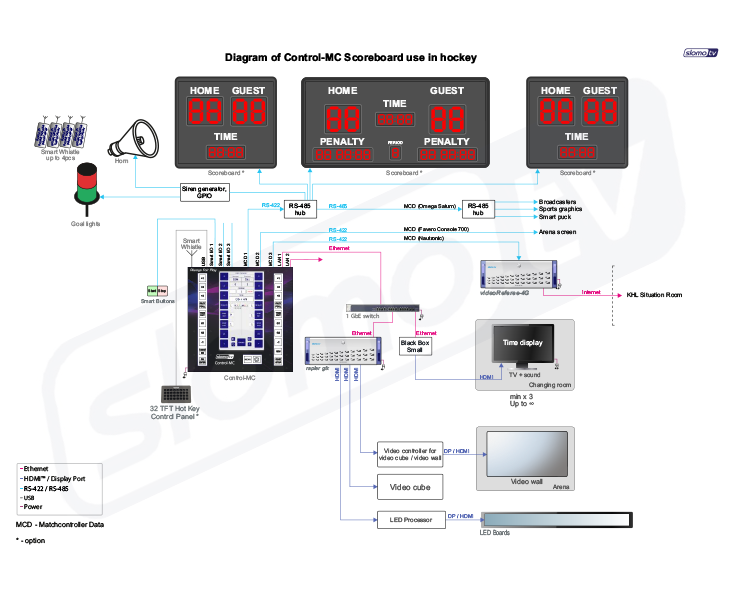
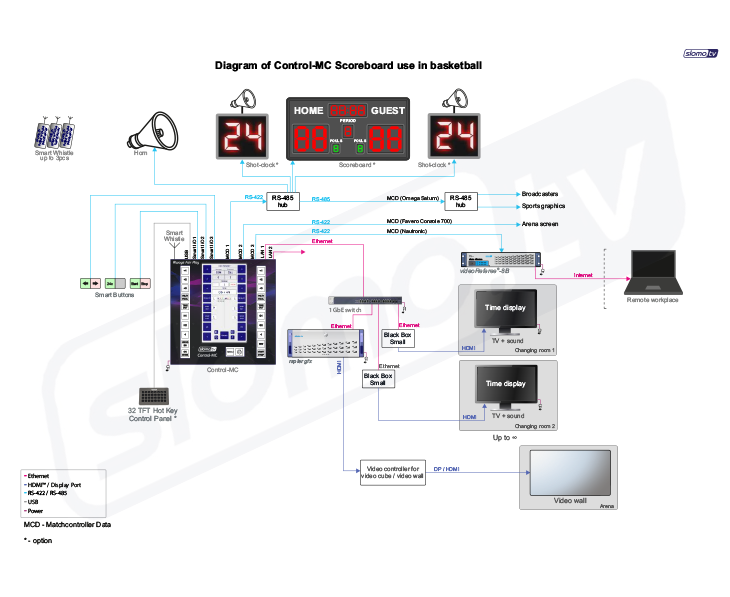
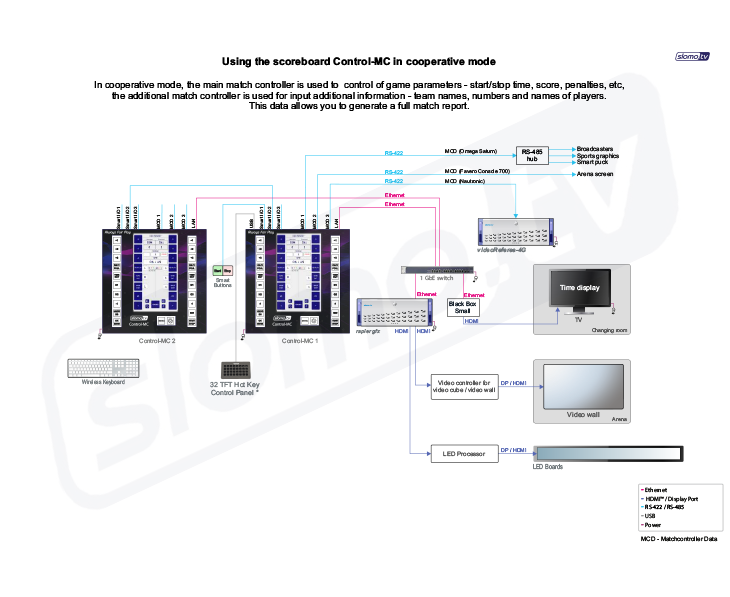
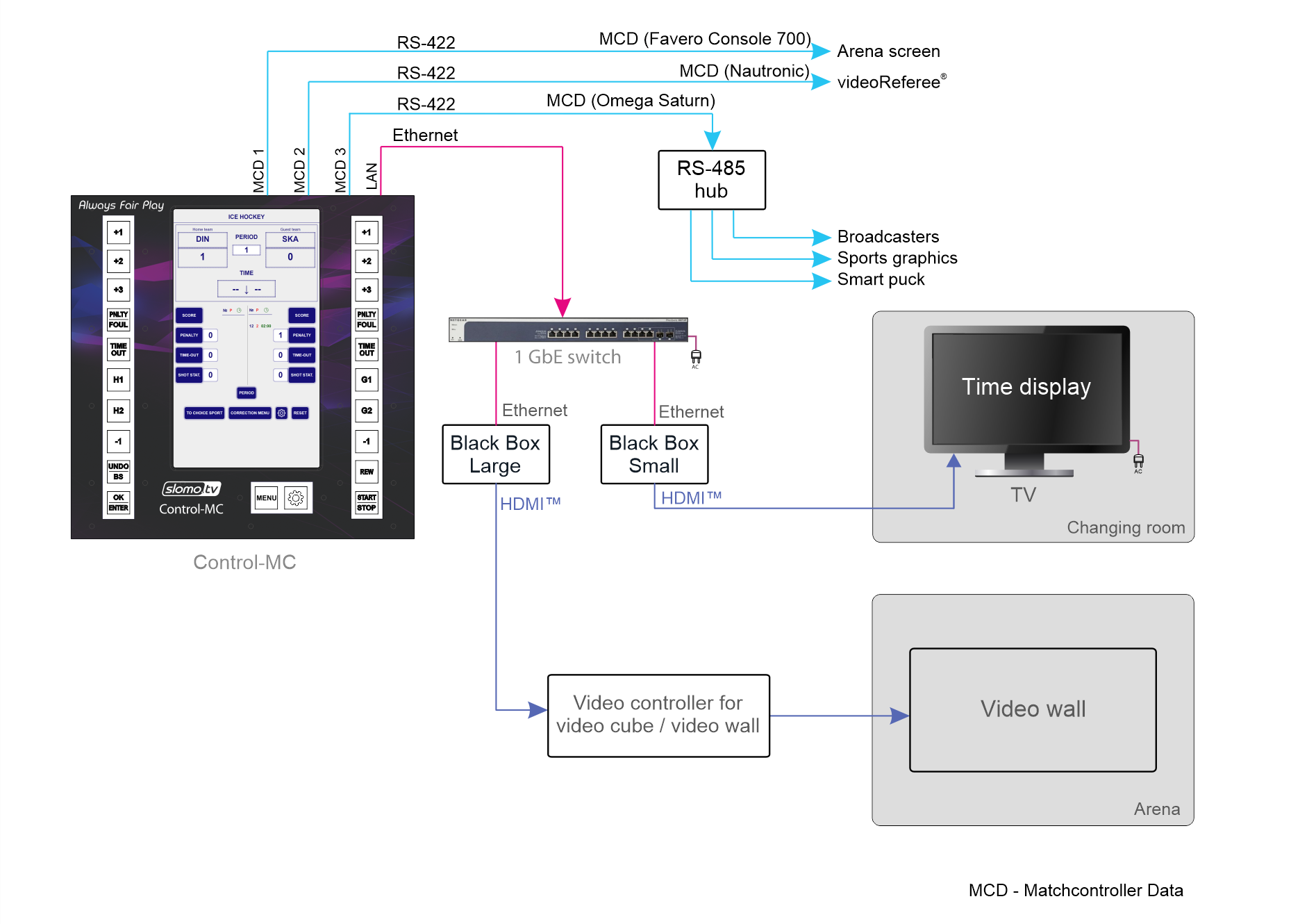
In addition to timing and event logging, the scoreboard controller transmits the generated match-controller data to users located not only in the arena, but also at remote locations. Among the standard users are arena displays, including video walls and video cubes, a VAR system, time-boards in dressing rooms, venue information graphics systems or TV graphics systems and additional devices, such as a "smart puck".
Data interfaces (MCD)
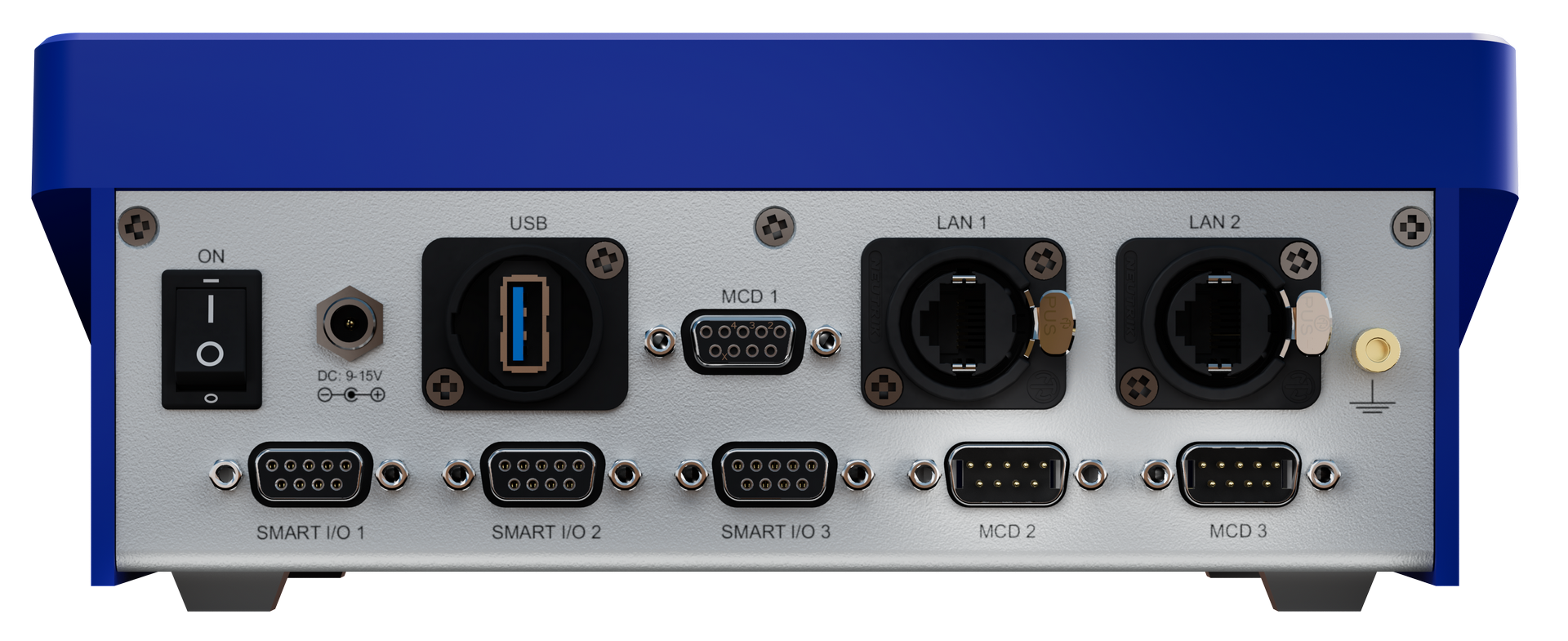
There are three serial interfaces RS-422/232/485 on the rear panel of the Control-MC, supporting various data protocols. Each interface can be assigned the type of a physical interface and the protocol.
Seamless integration with the most existing equipment in the arena and at the broadcaster is ensured thanks to the ability to assign to each MCD interface the type of physical interface and the data protocol type. Each data user works comfortably and properly. For example, the equipment in the arena supports the Nautronic protocol, and the broadcaster's sports graphics system uses the Omega protocol on the RS-232 physical interface. In this case, the MCD1 port is configured as RS-422 with Nautronic protocol and the MCD2 port is configured as RS-232 with Omega protocol.
Three Smart I/O ports
On the rear panel there are also three Smart I/O connectors for remote controls and various external devices. This can range from simple LED buttons (up to 2 buttons per connector) with "start", "stop", "24 seconds" and other functions, to slomo.tv devices that include various multi-button specialized interfaces, that greatly speed up and facilitate the work of the VAR team.
The Smart I/Os can also be used to connect additional MCD users.
Two Ethernet ports
There are also two Ethernet connectors for transferring MCD to devices that do not require high accuracy and data synchronization, and for connecting various control or information devices via HTTP / WebSocket protocol.
Users can connect their own devices (phones, tablets) with configured information management applications.
In addition, Control-MC has an integrated interface for a wireless mouse or keyboard and a software-controlled USB interface.
A wireless keyboard makes working with data tables much easier.
Rear panel of the Control-MC Scoreboard controller
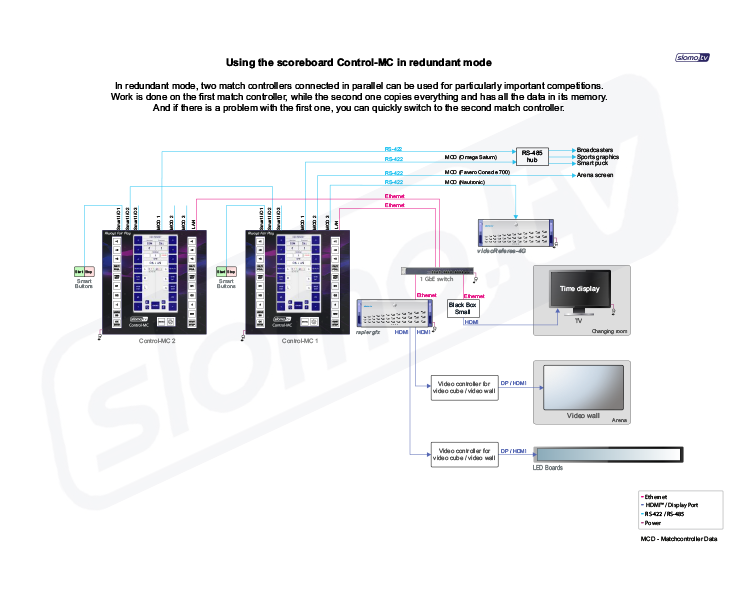
Possible use of Control-MC
More than a scoreboard controller – Unique features and options of Control-MC
Smart Whistle – Start and stop time by referee's whistle
The Control-MC offers the innovative wireless Smart Whistle function: the time on the scoreboard controller starts and stops by the referee's whistle. Up to 3 whistles can be connected. The system logs whose whistle was used to stop/start time. The Smart Whistle operates in the unlicensed 433 MHz band and provides a range of up to 100 meters. This function is seamlessly integrated and does not require the connection of external devices.
MCDO – Accurate and synced TV graphics
For TV broadcasters who produce on-air graphics from a broadcasting center there is a MCDO option. The option includes additional multifunctional devices with SDI input/output. Using the proprietary slomo.tv technology, the device on the arena embeds scoreboard controller data into the video signal sent to the broadcaster via any communication channel. Several embedding methods can be used: watermark, AUX Data and audio. The response device installed in the TV center retrieves the data. When the MCDO is connected via USB to the graphics system, the broadcaster gets a time reference for each frame and the ability to overlay the graphics with maximum accuracy.
MCDD – Monitoring and diagnostics of the scoreboard controller data feed
Significantly simplifies system setup and tune-up in large arenas. This option can also serve as a scoreboard controller test data generator. By selecting the interface and protocol, the user can connect to the existing infrastructure in the arena to test its functionality.
Smart Box – Information output on additional displays
In order to cover a wide range of possible needs, an additional Smart Box device has been developed for the Control-MC. The compact device (15 cm х 10 cm х 4 cm) connects to the Control-MC via standard Ethernet and outputs the selected game information on a standard HDMI™ display: time, time and score, goals, penalties, etc. It enables an information board to be organized in any place of the arena in accordance with league and federation regulations.
An expanded version - the Big Smart Box - is also available, allowing for more complex information and graphics to be generated on the HDMI™ output and delivered to video cubes and other displays.