
Multiviewers in video production
No large-scale video production is possible without a multiviewing system. All participants in the process – directors, technical staff, replay operators, producers, sound engineers, as well as personnel and specialists involved in the event management – need to have video feeds from multiple cameras simultaneously to make informed decisions in real time.
A multiviewer receives signals from as many video sources as possible (for example, cameras, software outputs, replay server outputs, graphics workstations, technical cameras) and delivers this information to the end user in a structured, easily interpretable way. Each end user requires their own customised set of video feeds tailored to their specific role and responsibilities.
It is also desirable for the end users to have control over the multiviewer layout: at one moment they may need a certain set of cameras focused on key action points, and at another moment a different set showing backup angles or supplementary feeds. The ability to dynamically reconfigure layouts ensures that every user sees exactly what they need when they need it.
A high-quality multiviewer is a sophisticated device with extensive capabilities – and typically a price to match. However, the investment is justified by the operational efficiencies it brings to complex productions.
MVWPro 2110 Development and Benefits
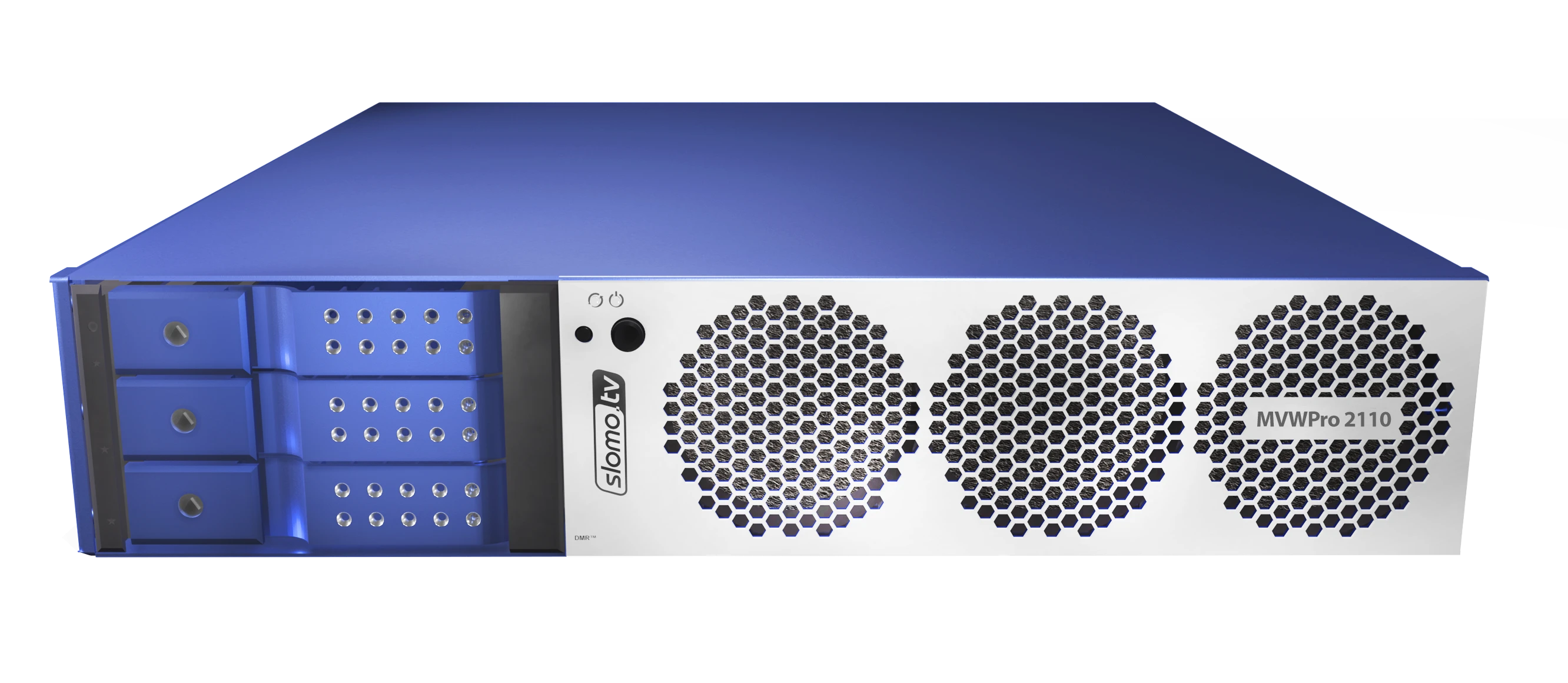
With the recently increased availability of ST 2110 equipment, SLOMO.TV team has developed cost-effective and reliable multiviewer MVWPro 2110 based on the Arrow-series to fit existing infrastructures while simplifying the workflow.
Benefits of using MVWPro 2110:
-
Reduced cabling infrastructure
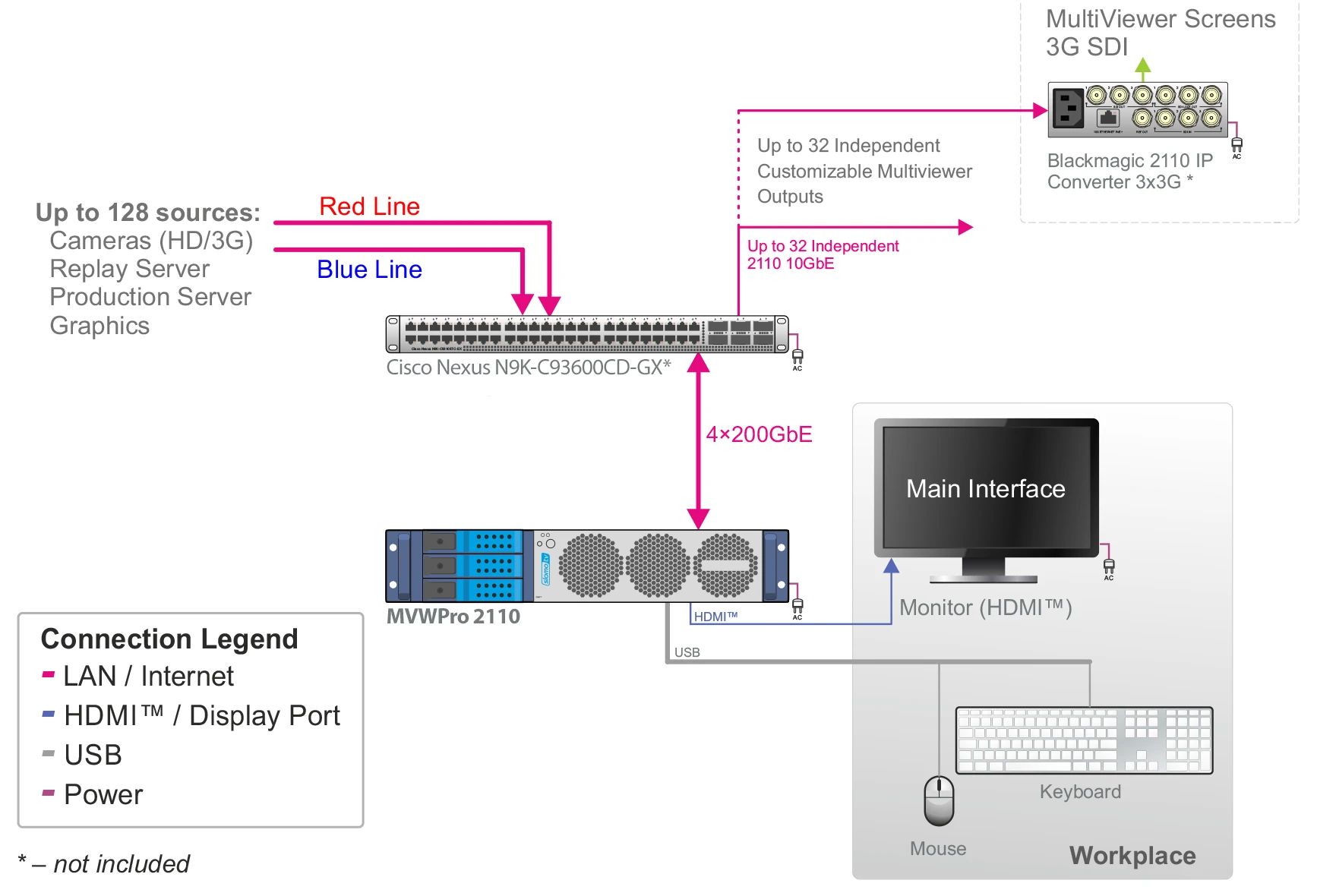
When working with a medium-sized event typically involving 64 video sources, using SDI would require 64 input cables for the "red" subsystem and 64 for the "blue" subsystem – a total of 128 cables. With SMPTE ST 2110, the entire setup runs on its infrastructure and is limited to just 8 optical cables connected to a router.
- Efficient channel transmission
ST 2110 enables remarkable density:
- 32 3G-SDI channels can be transmitted via a single connector;
- 8 UHD channels can travel through one cable;
- A single 100 Gb connector supports up to 100 video streams.
This drastically reduces the physical space required for equipment, cables, and connectors – a major improvement over traditional setup.
- Customizable output signals
Multiviewer's output signals are carried by the same cabling infrastructure. MVWPro 2110 delivers 32 fully customizable channels, each supporting layouts with up to 128 windows. The ability to dynamically reconfigure layouts makes it even more convenient.
ST 2110 enhances this flexibility further:
- A 100 Gb interface can be configured for either 8 UHD or 32 HD channels;
- The quantity of inputs/outputs is no longer hardware-bound – the software licensing determines capabilities;
- Resolution changes require only reconfiguration of devices (server, router, graphics equipment, multiviewer), without the need for physical cable swaps.
- Ethernet-based video distribution
Using ST 2110 signal allows using the Ethernet infrastructure to transmit video to any location. This approach is much more cost-effective than using standard coaxial cables.
Additional advantages include:
- Support for mixed video signals (e.g., UHD input, UHD playback, 3G for PGM OSD, PVW OSD, and multiviewer output);
- Ability for a single device (e.g., server) to act as a router when sufficiently powered;
- Use of standard SFP cables even for UHD 4K (no special connectors required).
- Higher bandwidth efficiency
While a single SDI connection carries just one video signal, a 10 Gbe Ethernet connection can transmit 3 video signals simultaneously. Higher-capacity options (200 Gb and 400 Gb) offer 2× and 4× performance respectively, further optimizing bandwidth usage.
- Built-in redundancy ("red" and "blue" subnetworks)
Video production of high-importance events requires fail-safe operation. With ST 2110, redundancy is implemented via "red" and "blue" subnetworks at the circuit board level – no extra hardware needed.
Future Development Plans for MVWPro 2110
SLOMO.TV team continues to enhance its solutions to meet evolving industry needs. Our plans for developing MVWPro 2110 further include:
- Increasing the number of output signals to 64;
- Implementing signal labelling for standard compliance;
- Displaying audio levels as graphs for intuitive monitoring;
- Supporting HDR signal input with conversion to SDR for optimal viewing on standard non-HDR monitors.
Connecting end users to MVWPro 2110
For connecting end users, we currently recommend a cost-effective solution using the Blackmagic 2110 IP Converter 3x3G.
This approach helps minimize infrastructure costs for SMPTE ST 2110 based deployments while maintaining high performance.