
- Details
Nowadays, scoreboard controllers are a vital component of any modern team sport. Scoreboard controller systems not only directly control and log the game information, but also create a protocol in the form of a file that can be used later for officials and statistics.
One of the most important characteristics of sports equipment is its impact on the game speed and slowdowns. If operations with the equipment — such as reviewing a disputed situation in video refereeing or making scoreboard controller changes — take a long time, it can result in teams losing their focus or advantage.
Scoreboard controller interface
For a scoreboard controller, simplicity and accessibility of the interface are necessary to minimally affect the course of the game. Frequently repeated operations should be performed as simply and intuitively as possible.
Scoreboard controller Control-MC by SLOMO.TV has evolved steadily since its launch in 2023. Our team regularly collects and analyzes feedback from venues and events where our equipment is deployed, using these insights to improve the systems. This iterative process has made our scoreboard controller notably faster and more reliable.
Simplifying complex operations with Control-MC
Let's imagine a frequently occurring situation: at the end of an ice hockey period, at the last minute of the match, an incorrect puck drop is performed. It is necessary to correct the game time, since the countdown has already been started, and start it again.
Typically, the operation on many scoreboard controllers is as follows: the video goal system is used to find out the time when the countdown started, and this time is entered into the scoreboard controller via the time adjustment menu — this process takes 30 to 60 seconds.
On Control-MC, this is done with a single press of the Undo button. The new puck drop can be performed as soon as the referee and players are ready.
- Details

Dear friends,
We wish you a magical holiday season filled with joy, warmth, and special moments shared with loved ones.
Your projects inspire us, and we are always ready to support your video production and VAR needs with dedication and care.
Here's to new milestones and shared achievements in the year ahead!
Warmest seasonal greetings,
The SLOMO.TV Team
- Details
High-speed data transfer: internet technologies and ST 2110
The development of internet technologies and progress in optical communication lines in the recent decade has been phenomenal. It has led to many providers being able to offer long-distance data transfer rates from 10 to 100 gigabits per second with minimal latency.
High-speed media transfer is also becoming available to a broader user pool with the recent developments in the affordability of equipment supporting the ST 2110 standard. Using standard IP technologies and transferring data without compression significantly speeds up the media transfer and saves resources at all stages of video production.
ST 2110 media transfer advantages for sports broadcasting
In sports broadcasting, especially live sports events, high-speed connections are critical for real-time decision-making when using video refereeing systems. Recent progress in telecommunications has made them accessible both economically and technically.
Transferring data with minimal delay is particularly important if the video judging system uses a VAR center setup, i.e. the cameras on the arena are transferring data to a remote location where the video refereeing servers are installed. Thanks to uncompressed signal transmission of ST 2110, the server in the VAR center has a delay of only several tens of milliseconds between an event happening on the arena and the signal being received, ensuring near-instantaneous review capabilities.
Furthermore, the affordability of modern IP equipment that is used by ST 2110 significantly reduces the cost of system implementation. Previously, transmitting a compressed JPEG XS signal required equipment costing 5–10 thousand euros per channel, whereas using ST 2110 and standard communication equipment makes 200 euros per channel sufficient. This cost reduction has democratized access to advanced VAR technology, making it feasible for a wider range of sports organizations. At the same time, network bandwidth has become significantly wider, allowing for multiple simultaneous streams and enhanced data throughput.
- Details
Why high-speed cameras must be used in sports
The world of sports is undergoing continuous transformation and development. In order to maintain the highest standards of fairness in competitions, modern technology has become an indispensable ally for judges and referees.
High-speed cameras are recognized as an exceptionally useful asset for the purposes of precise observation and analysis of fast-moving action, as the human eye has perceptual limits.
In such critical circumstances, even the most minuscule movement has the power to dramatically alter the fate of an entire competition. High-speed cameras, acting as the all-seeing eyes, offer referees and sports officials an unparalleled, meticulous view of the events unfolding before them.
High-speed cameras provide not only aesthetic value but also precise technical data. Their primary functions include:
- Enhancing the accuracy of video refereeing systems;
- Determining the exact positions of athletes, equipment, and field markings;
- Capturing beautiful moments and emotional content.
Modern high-speed cameras provide flexible placement options, feature PoE/Ethernet connectivity for convenient management and control, and require minimal technical expertise to operate effectively. They also are compatible with widely available standard equipment and can be easily set up for use during competitions.
- Details
The world of video production is constantly evolving, and one of the latest advancements is the SMPTE ST 2110 suite of standards. It has the potential to transform the way media is transmitted and processed in the whole industry. Let's take a closer look at the advantages ST 2110 provides and its influence on the industry's development.
The Evolution of ST 2110
The ST 2110 standard was introduced in 2017. At that time, its implementation was challenging and financially unfeasible for most studios, with the exception of major ones. However, with the advancement of electronics and software, as well as the contributions of companies like Blackmagic Design, ST 2110 is now poised to become a breakthrough in media transmission technology for video production.
The Revolutionary Benefits of ST 2110
The ST 2110 standard addresses the shortcomings of the previous SMPTE standards and introduces a new level of efficiency, reliability and comfort in video production.
One of the primary advantages is the need for considerably fewer connections. Also, instead of point-to-point connections, IP technologies are used, allowing multiple streams to be transmitted over TCP/IP.
Here are some specific benefits of using ST 2110:
- Details
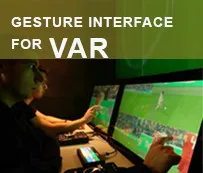
Simplifying complex system management for broadcasting, LED shows, and sports video refereeing
With intricate systems, such as those involving server networks, interface and configuration software play a vital role. These tools are designed to streamline the management and setup of such systems, enhancing accessibility for users who may lack in-depth technical expertise. This is particularly important in environments requiring rapid deployment and efficient operation, such as in broadcasting live events, production of huge LED surface shows and sports video refereeing.
Understanding launcher applications hinges on grasping the concept of their interface. While numerous definitions regarding the ideal interface exist, Igor Vitiorets, CTO at SLOMO.TV, thinks that the most effective interface facilitates the execution of recurring tasks in the simplest, fastest and most intuitive way possible. This is particularly important in complex systems like server networks, intercom networks, OB van configurations, where users require access to a diverse array of functionalities. This approach ensures that any operator can quickly adapt to the system and perform their tasks efficiently, reducing the learning curve and increasing productivity.
- Details
The video refereeing system is an important component of modern sports, providing the opportunity to make correct decisions based on factual circumstances that may not be detected with the naked eye.
Video refereeing systems require extensive management: human resources, technical resources, administrative resources, regulations, interaction between teams and referees, operators of the video systems, and many more.
Challenges associated with different setups of VAR systems
Based on our experience, the current significant challenge is the lack of sufficiently qualified personnel, which affects everything. By utilizing local systems situated at the stadium or match venue, the issue is that the working staff are effectively unavailable for a specific duration, being dedicated solely to one match, which additionally includes travel to and from the event. The complication is that personnel assigned to one match cannot be utilized for other events for a significant time.
- Details
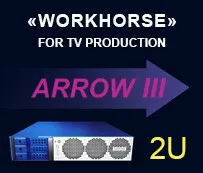
SLOMO.TV is excited to introduce the new Arrow 4K, a new broadcast-grade 2U server designed to provide an easy and affordable way to work with 4K replays, adding to the 4K server range following the success of the Simple R 4K in 2023.
The Arrow 4K is the successor to the highly popular and reliable multi-channel recording and replay server, the Arrow III. Its compact dimensions (2U, 88 x 482 x 512 mm) and lightweight design (12 kg) make it an ideal choice for mobile solutions and integration into existing studio and OB van infrastructures.
Professional 4K replays have never been this accessible
The availability of cost-effective 4K cameras like the Blackmagic URSA Broadcast has enabled small and medium-sized companies to produce high-quality 4K sports broadcasts. SLOMO.TV has developed the Arrow 4K system to cater to URSA Broadcast users, allowing smaller studios to compete in the sports video production market.
With 4K Replay mode supporting 4 recording channels, Super Motion camera support and network functionality, the Arrow 4K is an ideal foundation for a multichannel recording and replay OB van subsystem offering compact, broadcast-grade instant slow-motion replays in 4K. This allows smaller studios to match the capabilities of larger, more expensive OB vans. With the Arrow 4K, SLOMO.TV continues to push the boundaries of 4K broadcasting, making it more accessible and affordable for companies of all sizes.
- Details
In modern sport, the quest for accuracy and fairness in decision-making has led to the integration of advanced technologies, particularly high-speed cameras. These cameras play a crucial role in various sports, especially in scenarios where split-second actions, where the human eye cannot capture the details, can significantly affect the outcome of a match. High-speed cameras provide an extra-detailed view of such events, helping referees and officials to make more informed decisions.
Although broadcast cameras capable of capturing high-speed video are widely used in sports, they have some limitations when used for video judging. Their availability is not always guaranteed, as broadcasters may have their own priorities or be unable to provide the footage for VAR purposes.
Camera and server integration
In order to be independent of the broadcasters and to be able to use the high-speed cameras in video refereeing, the user needs a balanced solution, which consists of two main components: the camera and the server. The server must be able to work seamlessly with the camera and vice versa.
- Details
In the rapidly evolving world of e-Sports the demand for high-quality engaging content has never been greater. Fans expect to see not only the action, but also the details that make each game unique.
By definition, e-Sports can be classified as a sport because it involves competitive activity. However, the broadcasting of e-Sports competitions is different from traditional sports.
In traditional team sports, the focus is on the ball or puck and the competition around it. In contrast, e-Sports such as Counter-Strike: Global Offensive, Call of Duty, League of Legends and DotA 2 are multiplayer video game competitions where every player's actions matter. This increases the complexity of broadcasting such competitions.
The broadcast director should be a professional who has to understand and feel the game and its specifics, the teams and individual players.
In most cases during an e-Sports competition, there are many rounds in a single game with short breaks. The director and producer have very little time to show the best moments of each round with commentary and explanations. Therefore, the replays play a more important role in e-Sports broadcasts than in traditional sports.