
What do we do with old hard drives that litter the warehouse?
Among the old huge, slow and heavy disk which where once insanely expensive, particularly stood out Micropolis 1991 (5.25, Full FH) SCSI hard drives.
There was a mischievous idea to test it for performance. We quickly found a SCSI controller with 8-bit FAST SCSI. Standard testing utility showed drive's brilliant performance and unmatched speed graph. I have not seen such speed in about 7 years. To be truthful, the initial speed of 8 and the final 3.7 megabytes /sec were unusual. But most importantly, the drive after 15 years proved to be workable! Its speed characteristics were just perfect in relation to the year of manufacture.
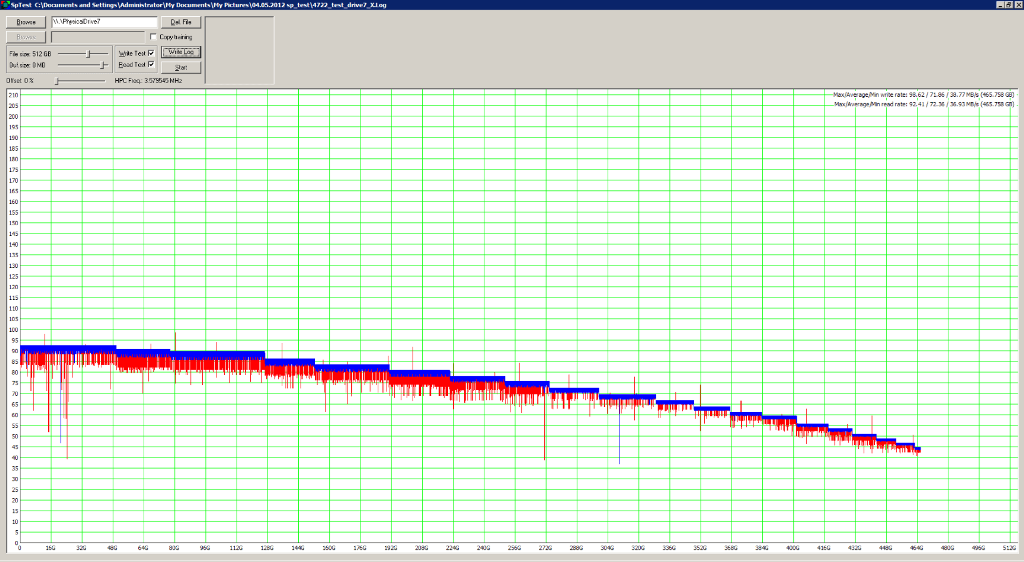
Back in 1997, this disc was selling for $4,500. Now USB FLASH with similar characteristics is $5. Progress!? Yes, but there is another side to all advantages.
Modern "spin" discs have very high read/write rate, huge volume and low price. This is the result of modern technology and algorithms of embedded software. The downside of this is that the drives have become less reliable and their speed performance graphs began to resemble a beard because of the huge and chaotic rate slowdowns. This is due to the fact that no hard drive platters are perfect. They have parts with unsatisfactory read-write performance which are bypassed by drive's firmware.
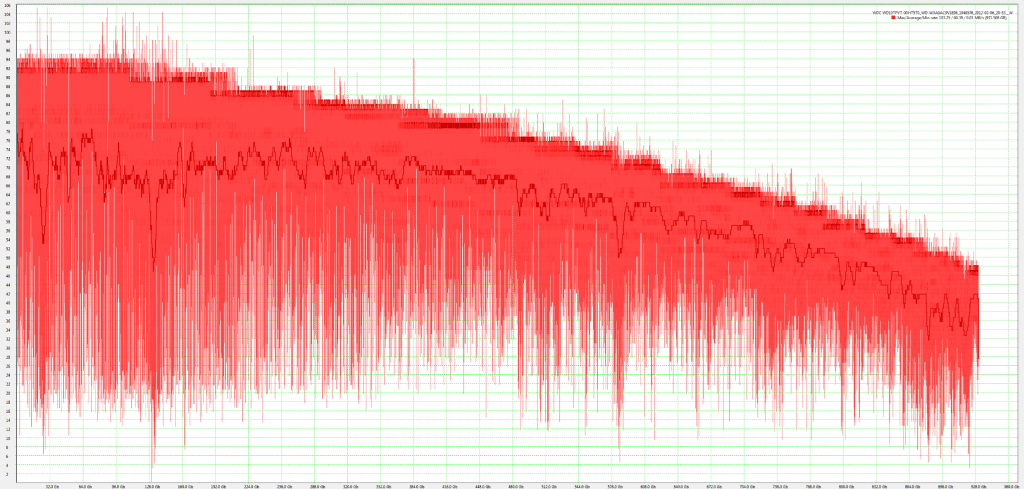
The lower peak performance may be ten times lower than the average rate expected by user. From the point of view of the manufacturer, such speed-rate drops are not errors. From the operating system point of view, an error is a timed-out write/read operation of 5-20 seconds! As a result, the user has a "working" hard drive, which constantly falls behind write/read operations.
- Details
- Written by: Igor Vitiorets